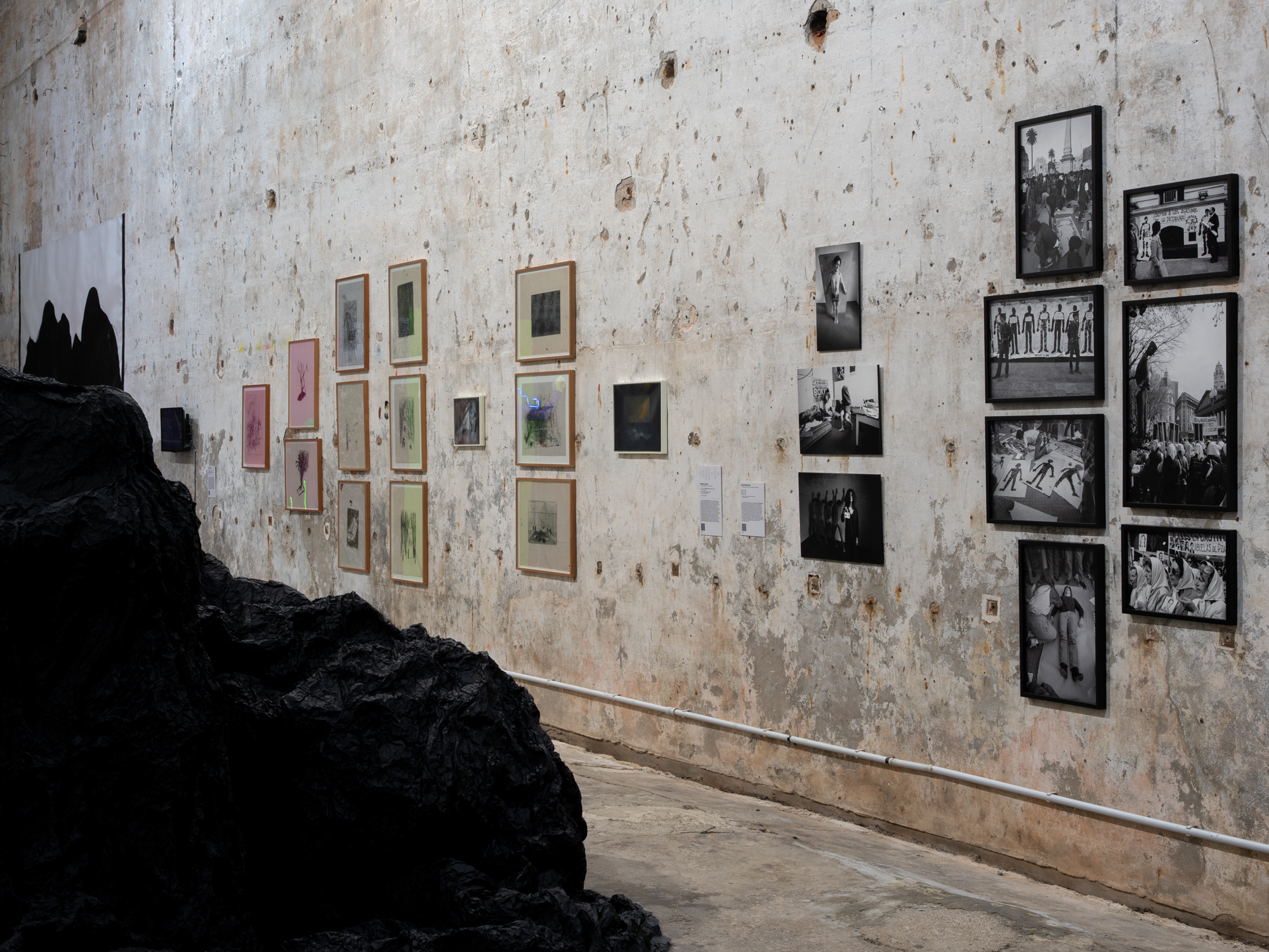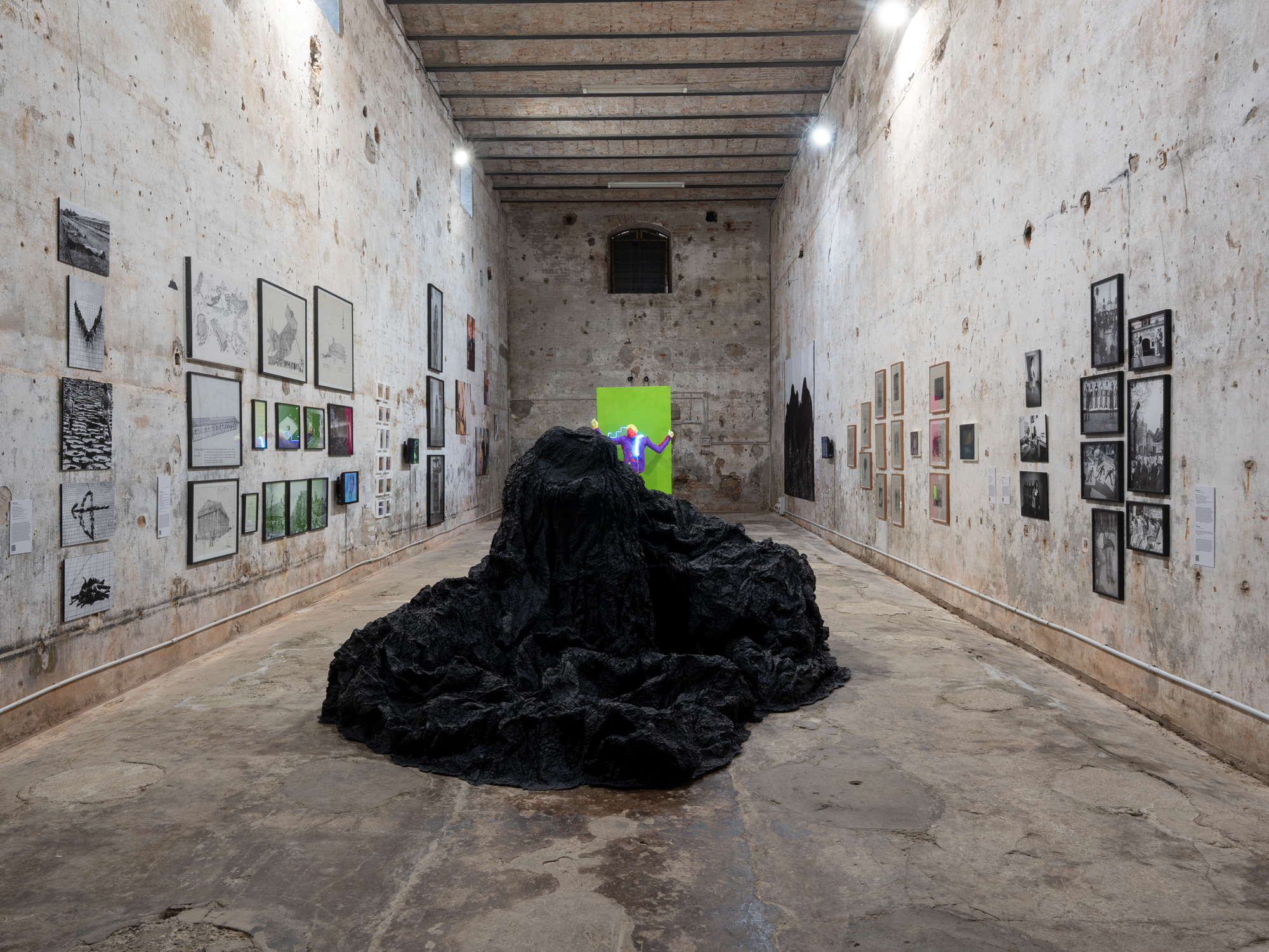


Darkness Visible: The Long Shadow of Dictatorship is an exhibition to mark the 50th Anniversary of the coup d’état that ushered in Argentina’s last military dictatorship (1976–1983), a regime of State terror that implemented a systematic policy of censorship, kidnappings, torture, murder and the forced disappearance of 30,000 people, while driving thousands more into exile and stealing the babies born to the women it held in captivity. Under this regime, the government brutally repressed all forms of artistic expression. This historic trauma left deep wounds in society, resulting in a trail of images, absences and scars that continue to shape how the violence is remembered, perceived and retold. Fifty years on from the start of this horrific chapter in Argentine history, and in light of the current threats to and attacks on democratic institutions worldwide, we consider it imperative to revisit the ways artists have addressed violence – both in its most overt and brutal manifestations and in its subtler, yet equally effective, forms.
Bringing together eighteen artists and collectives, mostly from Argentina and from a wide range of generations and works spanning the 1970s to the present, this exhibition positions art (with its understanding of the sensory and of the power of the body, and its capacity to move along the threshold between the visible and the invisible) as a vehicle for understanding history, protecting memory and human rights, engaging in activism against State terror and raising awareness of violence. The exhibition includes works by major contemporary artists who responded to this historic moment with concern, condemnation or criticism; artists who embodied the transition from dictatorship to democracy; and artists who continue to denounce the violence that prevails in contemporary societies and the increasing physical and psychological violence against women and LGBTQ+ communities, most notably in the form of femicide.
In Paradise Lost (1667), John Milton uses the term “darkness visible” to describe Hell. This oxymoron serves as an apt metaphor for the role of the visual arts in bringing to light what has been hidden or censored and yet remains unbearably present. By bringing together the work of artists who have faced the horrors of violence in its many forms, the exhibition raises questions: How can art give visibility to bodies, ideas and lives that were forcibly disappeared? What visual and cultural forms have the power to denounce atrocities without reproducing mechanisms of spectacle or banalisation? How is historic trauma passed down, transformed and reinterpreted across generations to keep the act of remembering alive? How does political authoritarianism intersect with gender-based violence? How can spaces for political participation and social interaction be created and upheld – in the streets, the underground or nightlife settings – in contexts of extreme authoritarianism? Given the current democratic instability across the globe, these questions take on a sense of urgency. The strategies devised by the artists of Darkness Visible protect memory and guide us through the shadows of the present.
The exhibition is structured around experiences of the dictatorship in Argentina, as a voyage through time culminating in the present. On entering, the visitor is greeted by works by León Ferrari and Marcelo Brodsky, two artists who endured the forced disappearance of family members during the dictatorship and made their denunciation of such crimes a lifetime cause.
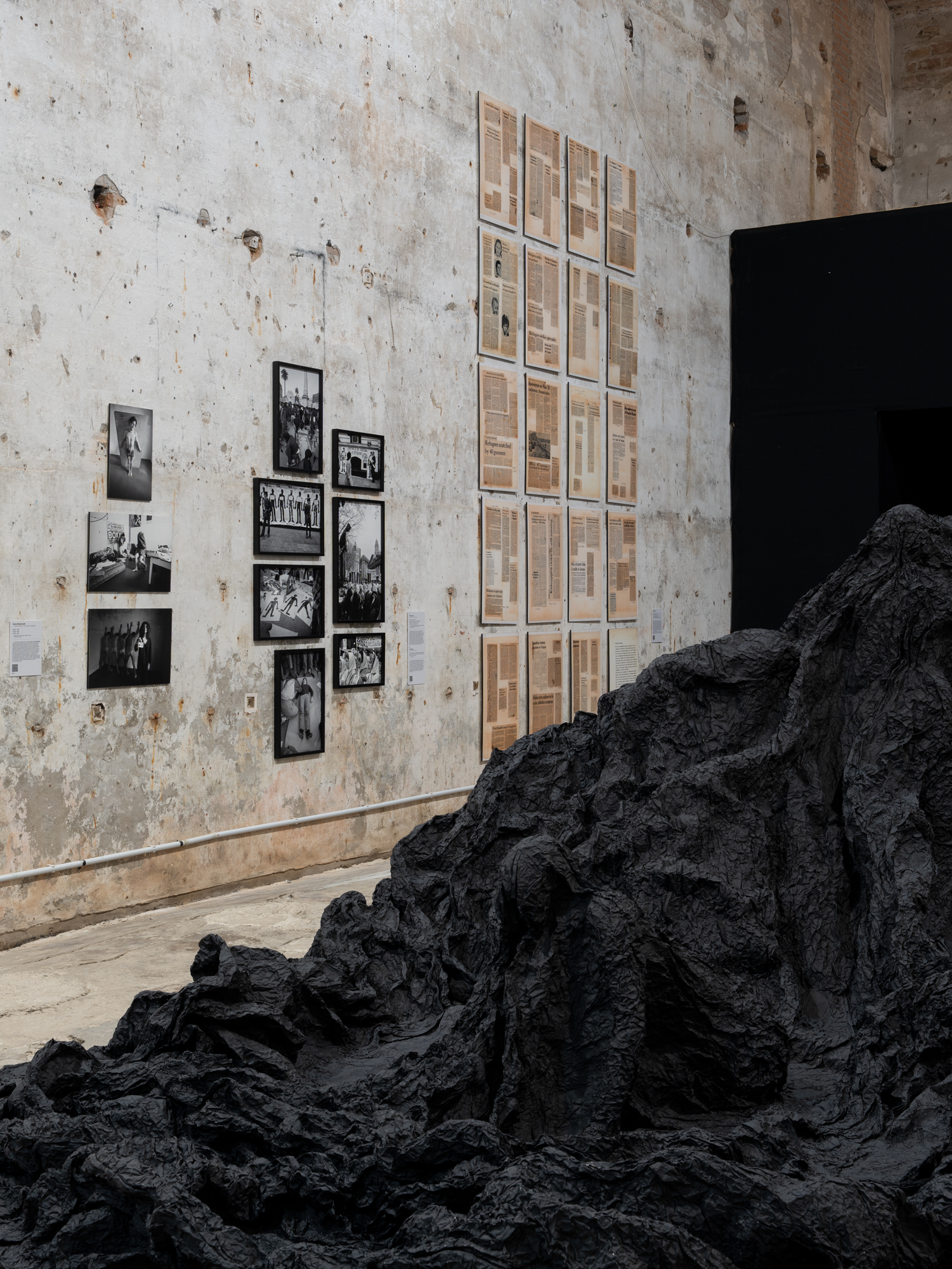
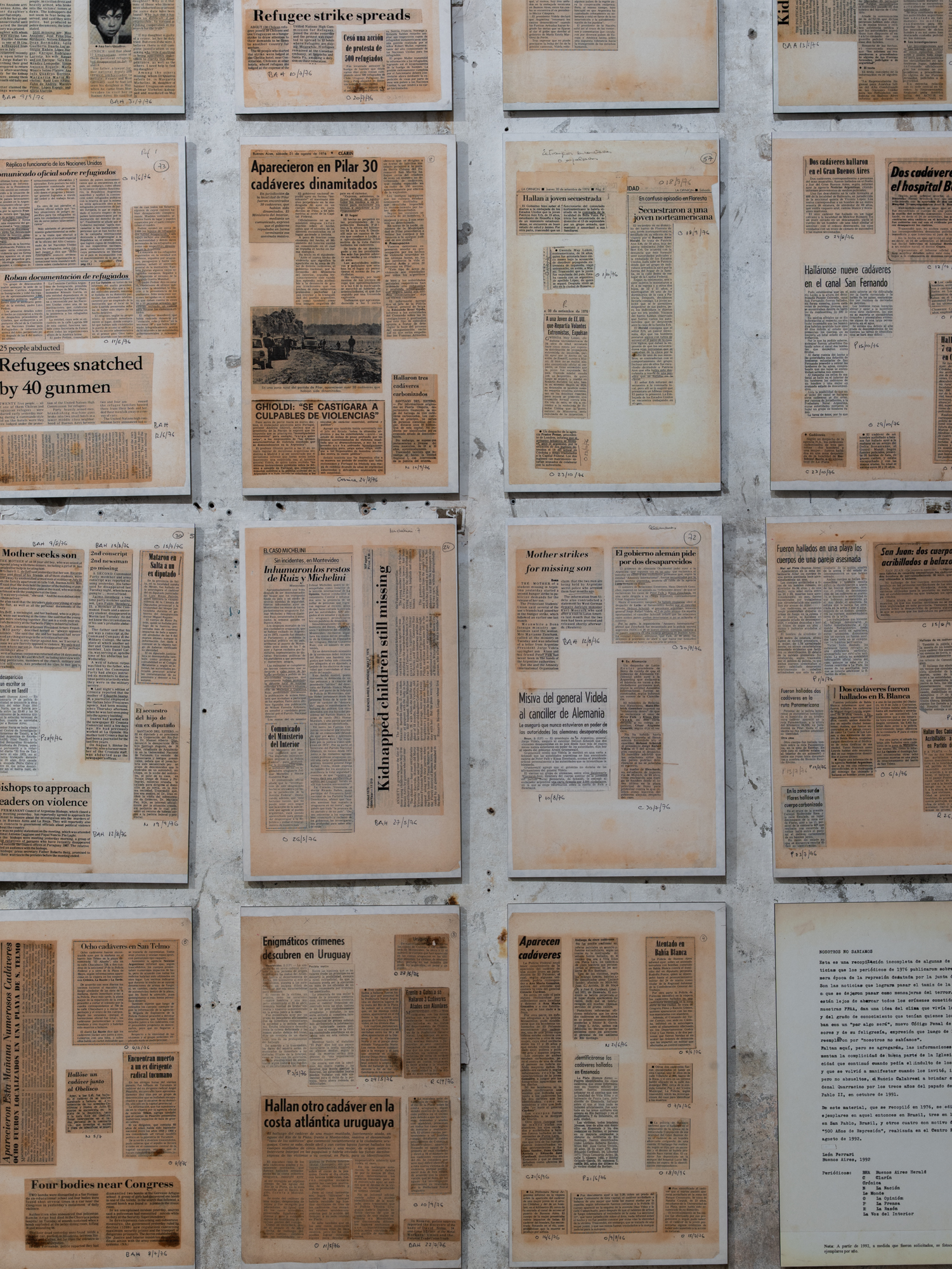
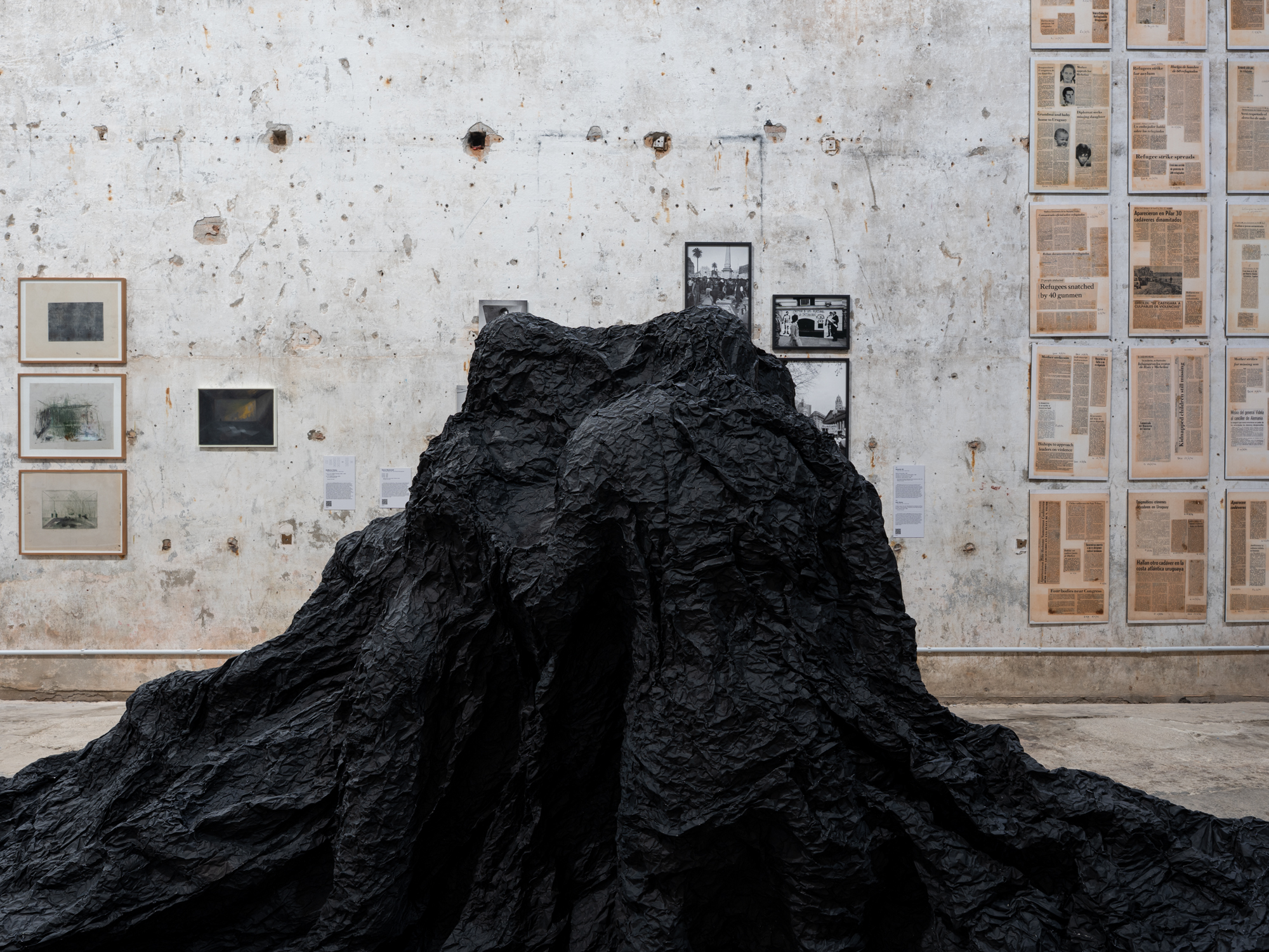
León Ferrari (Buenos Aires, 1920-2013) devoted his life to calling out the horrors of authoritarianism, the abuse of power and the crimes against humanity unleashed by the Vietnam War and the last military dictatorship in Argentina (1976-1983). A prolific artist and tireless activist, in his series “Nosotros no sabíamos” [“We Didn’t Know”] – composed of 83 collages of newspaper articles from 1976 – Ferrari denounced crimes against thousands of civilians during that year in Argentina, dismantling the social argument that claimed civilian ignorance, showing that State violence was present in the media and thus visible, legible, and systematically denied. As Ferrari explained in 1992, these were “news items that managed to slip through the filter of censorship, or were allowed to pass as messengers of terror.” The series turns the viewer into a belated witness, confronting them with their own ethical position. Through accumulation and repetition, it reveals how journalistic language contributed to normalizing terror. As a tragic coda to this series, Ariel Adrián Ferrari, the artist’s son, was kidnapped by the military on February 25, 1977, and later forcibly disappeared. The series was discontinued as León embarked on a lifelong quest to find out what had happened to him.
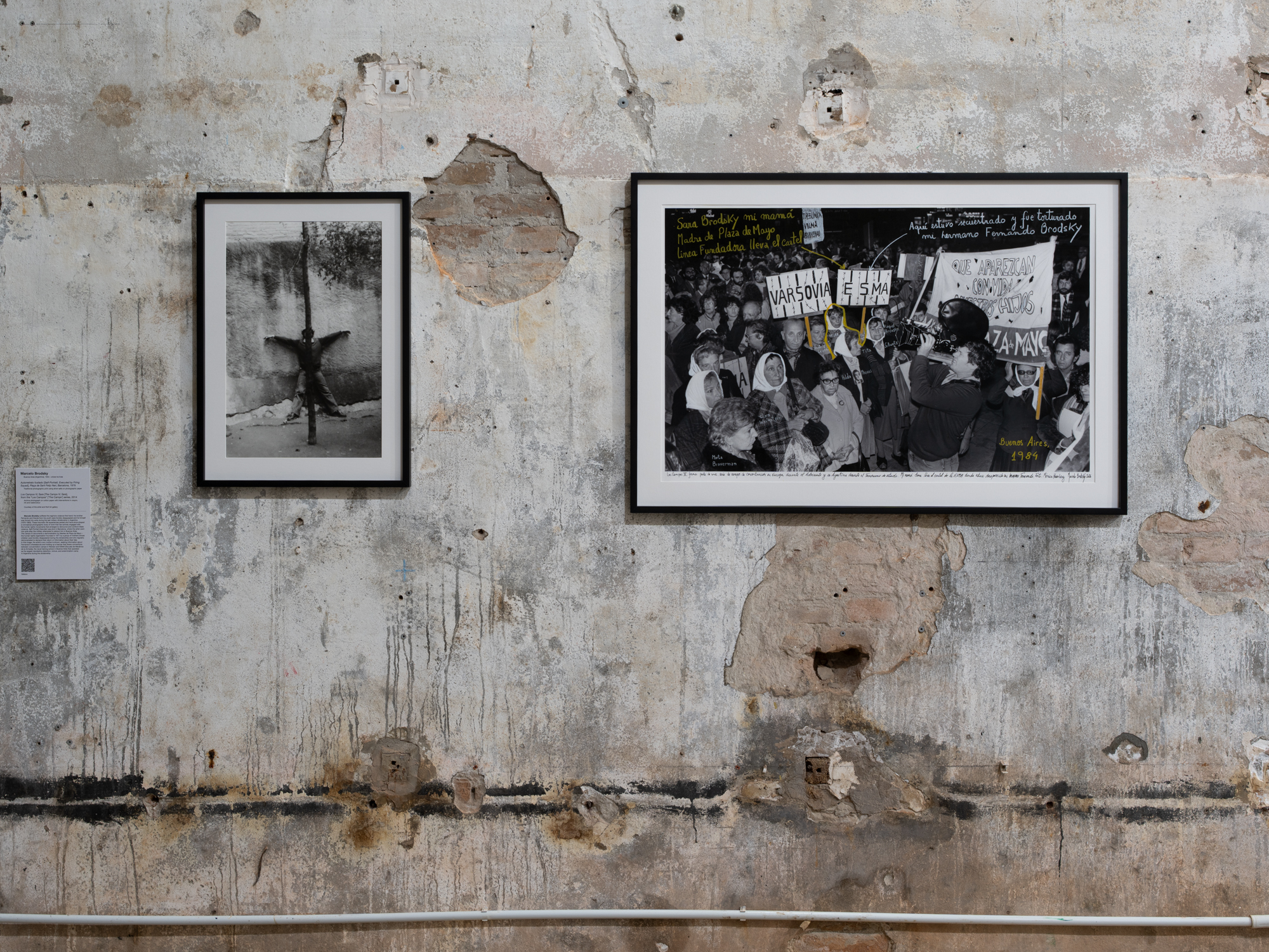
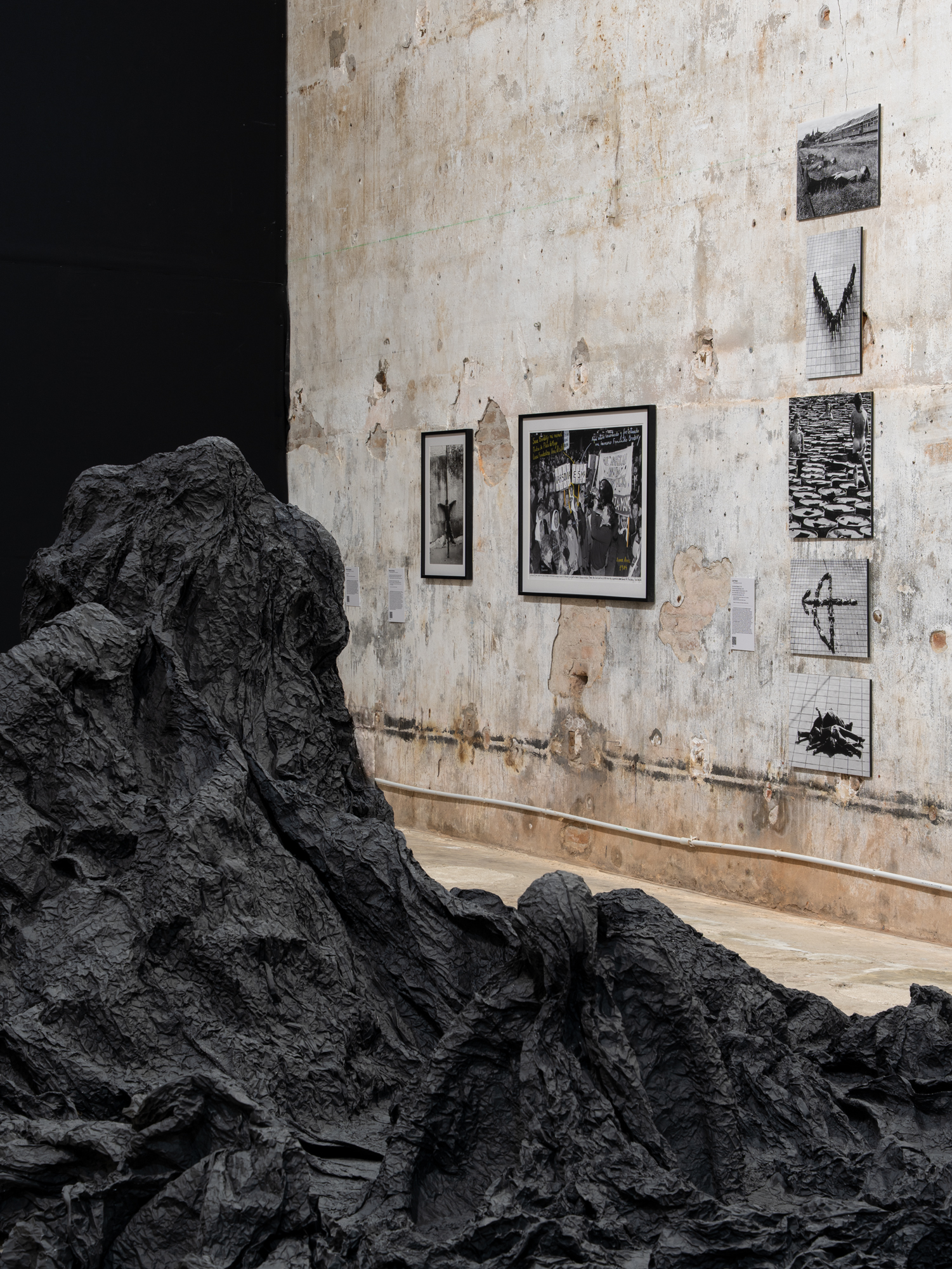
Marcelo Brodsky (Buenos Aires, 1961, where he lives and works) also suffered the regime’s violence first-hand: his brother Fernando and friends from his youth were forcibly disappeared and he himself was forced into exile during the last military dictatorship in Argentina. These traumatic life experiences persist and have since shaped a conceptual photographic body of work that has actively engaged with the human rights movements that emerged to denounce and confront State violence. Autorretrato ejecutado [Self-Portrait Executed] (1979) was shot in Barcelona, where the artist went into exile after the military attempted to abduct him in Buenos Aires. Los campos, IV [The Camps, IV] documents a demonstration by Madres de Plaza de Mayo – the human rights organisation founded in 1977 by a group of mothers whose children had forcibly disappeared during the dictatorship and who regularly demonstrated at Plaza de Mayo to demand their return or information about their fate. In this image, the artist’s own mother is shown, seeking information about Fernando’s whereabouts and holding up a banner that draws connections between concentration camps in Warsaw and ESMA (Escuela de Mecánica de la Armada), the naval training school in Buenos Aires that operated as the largest clandestine detention, torture, and extermination camp in Argentina during the dictatorship.
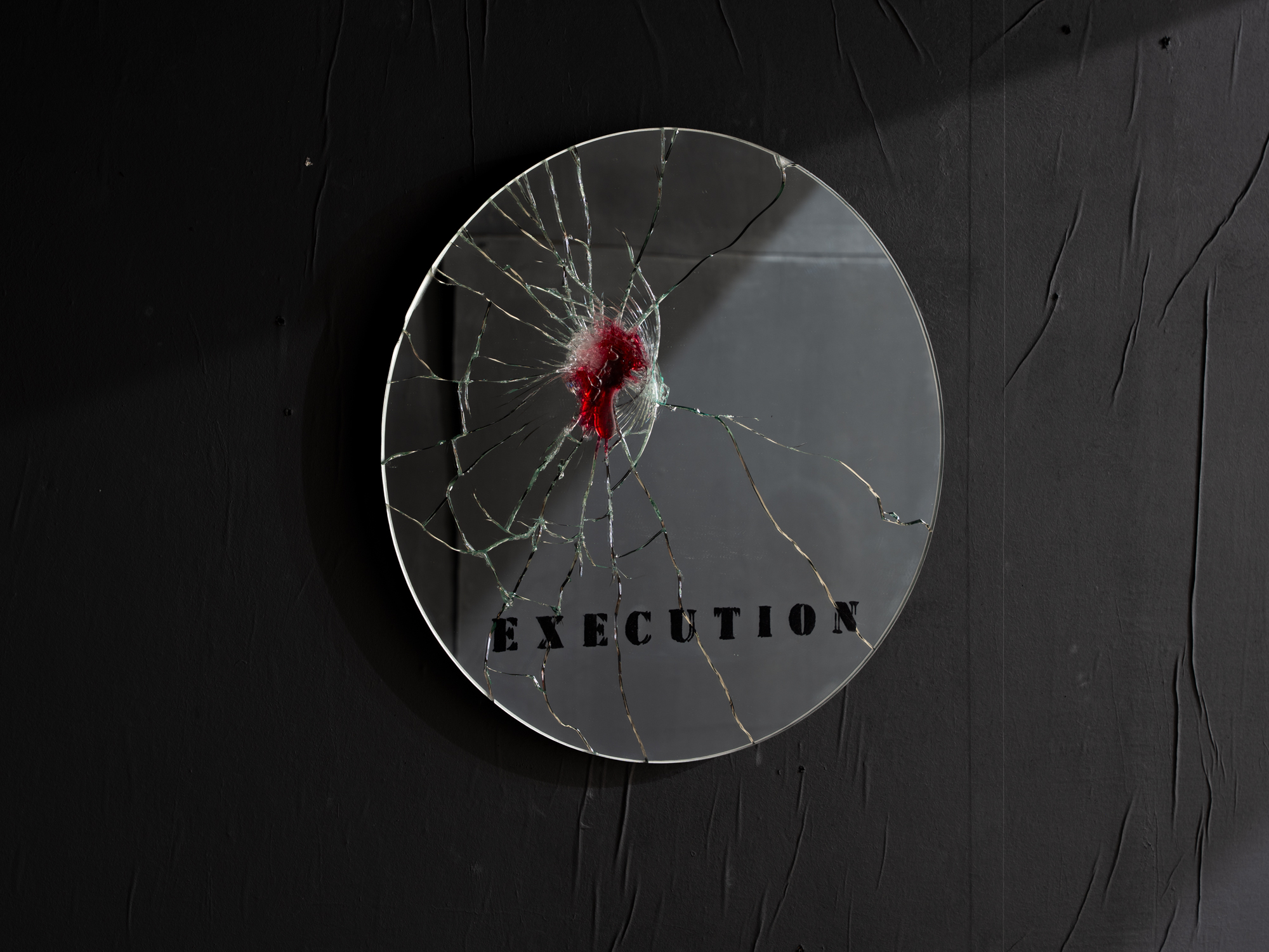
Uruguayan artist, writer, educator and activist Luis Camnitzer (b. Lubeck, 1937; raised and educated in Montevideo; lives in Great Neck, New York) has devoted his life to affirming the importance of art as a vehicle to critically analyse reality and effect concrete change. A leading figure in Latin American conceptual art, Camnitzer considers himself an ethical anarchist concerned, in his own words, “with the equal distribution of power and with the role education might have in achieving it.” Having contributed to reforming the School of Fine Arts in Montevideo in 1960, during the next decade he followed closely the political turmoil in the Southern Cone and, understanding art as politics, denounced the excesses of violence rife in the region’s military dictatorships. Execution (1970-2026) is the result of an early conceptual strategy to confront political violence. Here, the shattered mirror is apparently struck by a bullet and the viewer sees their own image fractured or shot. Are we the killer? Are we the victim? Unlike his previous work This Is a Mirror. You Are a Written Sentence (1966–68), where the mirror invited linguistic reflection on identity, here conceptual reflection becomes a direct encounter with violence.
Conceptual artist, visual poet, and journalist Luis Pazos (La Plata, Argentina, 1940-2023) also anticipated the mass violence that would soon occur when he created Transformaciones de masas en vivo [Live Mass Transformations] (1973) with high school students from Colegio Nacional Rafael Hernández in La Plata. A central figure in the city’s experimental conceptual scene – where practices such as visual and experimental poetry, mail art, and happenings expanded the boundaries between literature, performance, and visual art – Pazos developed his work through his formative relationship with artist and theorist Edgardo Antonio Vigo (La Plata, Argentina, 1928-1997), a key figure in international avant-garde networks who taught drawing to the school’s students. Through these collective actions that the artist referred to as “living sculptures”, photographed at his request by Carlos Mendiburu Eliçabe, Pazos explored the body not only as a sculptural and visual element but also as a political medium, an agent of collective change. This series of photographs documents ephemeral actions in which the group gathers to form simple visual configurations or political symbols – i.e. in reference to Peronism – in the public space of the schoolyard as well as in uninhabited urban spaces, exploring possible dramatic choreographies, and the shifting geometries of the social body. In some images, the bodies appear sprawled across the ground, creating poses that acquire an ominous charge in retrospect, as several of the performers would be among the many students forcibly disappeared by the military Junta that came to power shortly after, in 1976.
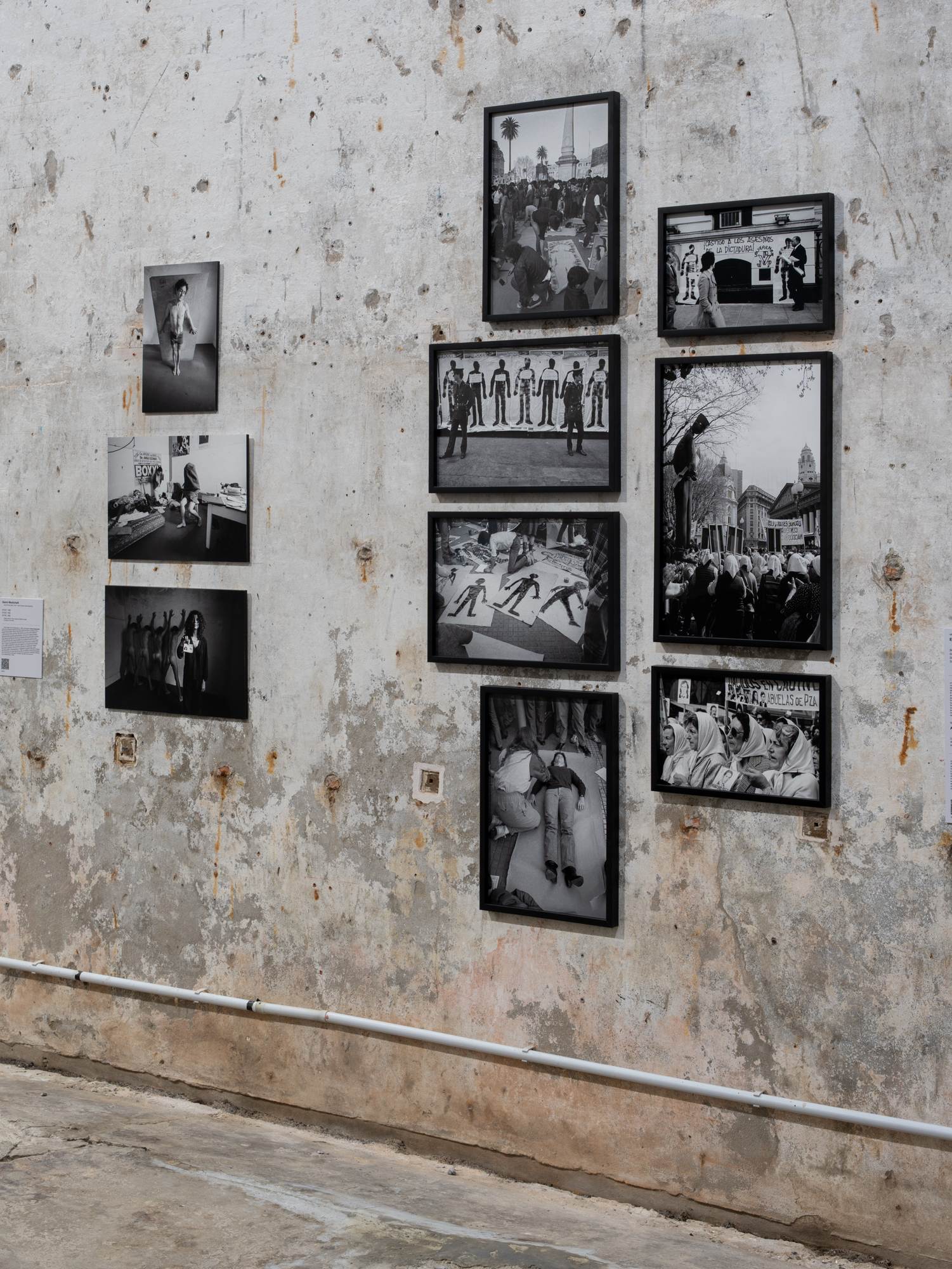
Eduardo Gil (Buenos Aires, 1948, where he lives and works) produced some of the most iconic photographic records of the so-called graphic action known as “El Siluetazo” which took place on September 21-22, 1983, on the occasion and as visual support of the Tercera Marcha de la Resistencia [Third Resistance Demonstration] organised by the Madres de Plaza de Mayo during the final months of the military dictatorship in Argentina. “El Siluetazo” was a collective action organised by artists and human rights activists Rodolfo Arregueberry, Julio Flores and Guillermo Kexel in which participants traced life-size silhouettes of their bodies on paper and pasted them in and around Plaza de Mayo to represent the people disappeared by the regime. Gil photographed the action as it unfolded, capturing not only the finished silhouettes but, crucially, the collective process of their making: bodies lying on the ground, hands drawing outlines, sheets of paper circulating, and the gradual occupation of this historic square in Buenos Aires. As a public intervention, “El Siluetazo” rendered absence visible. León Ferrari would later describe it as “a masterpiece in both political and aesthetic terms.”
The photographic practice of Aldo Sessa (Buenos Aires, 1939, where he lives and works) has been notably driven by a profound obsession with documenting urban life and capturing the heartbeat of Buenos Aires across decades, all of which has led to the creation of a monumental archive of over 5,000,000 photographic images. This fascination has led him to witness pivotal moments in which the public space has been reclaimed as a site for democracy, as was the case of “El Siluetazo”, also photographed by Eduardo Gil. Sessa registered the early demonstrations against the military dictatorship, documenting the courage of human rights organisations founded in 1977 – the Madres de Plaza de Mayo and the Abuelas de Plaza de Mayo – who called for the return of their disappeared children and grandchildren and demanded that the military government locate and restore the identities of illegally appropriated children, many of them born in clandestine detention centres.
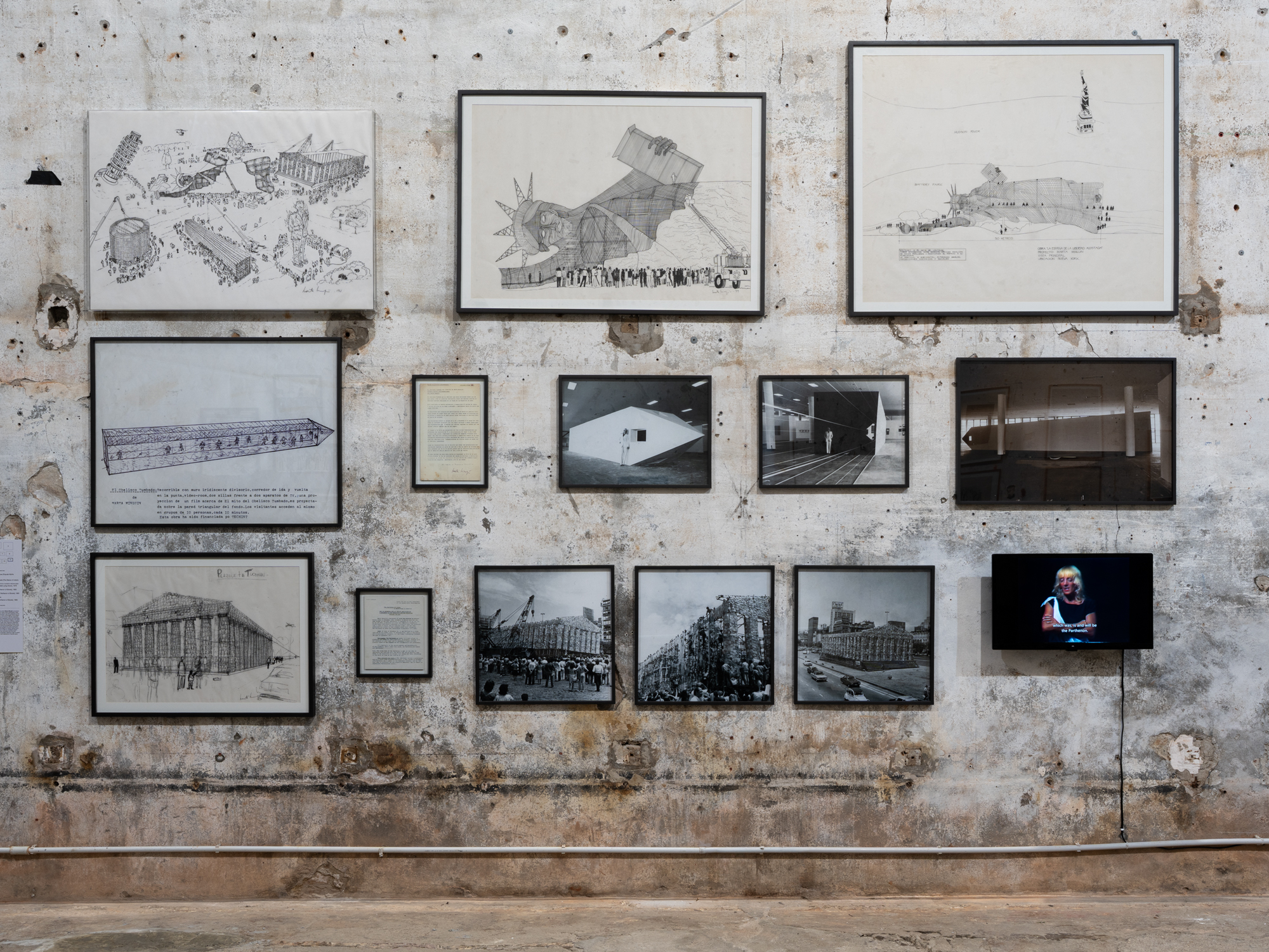
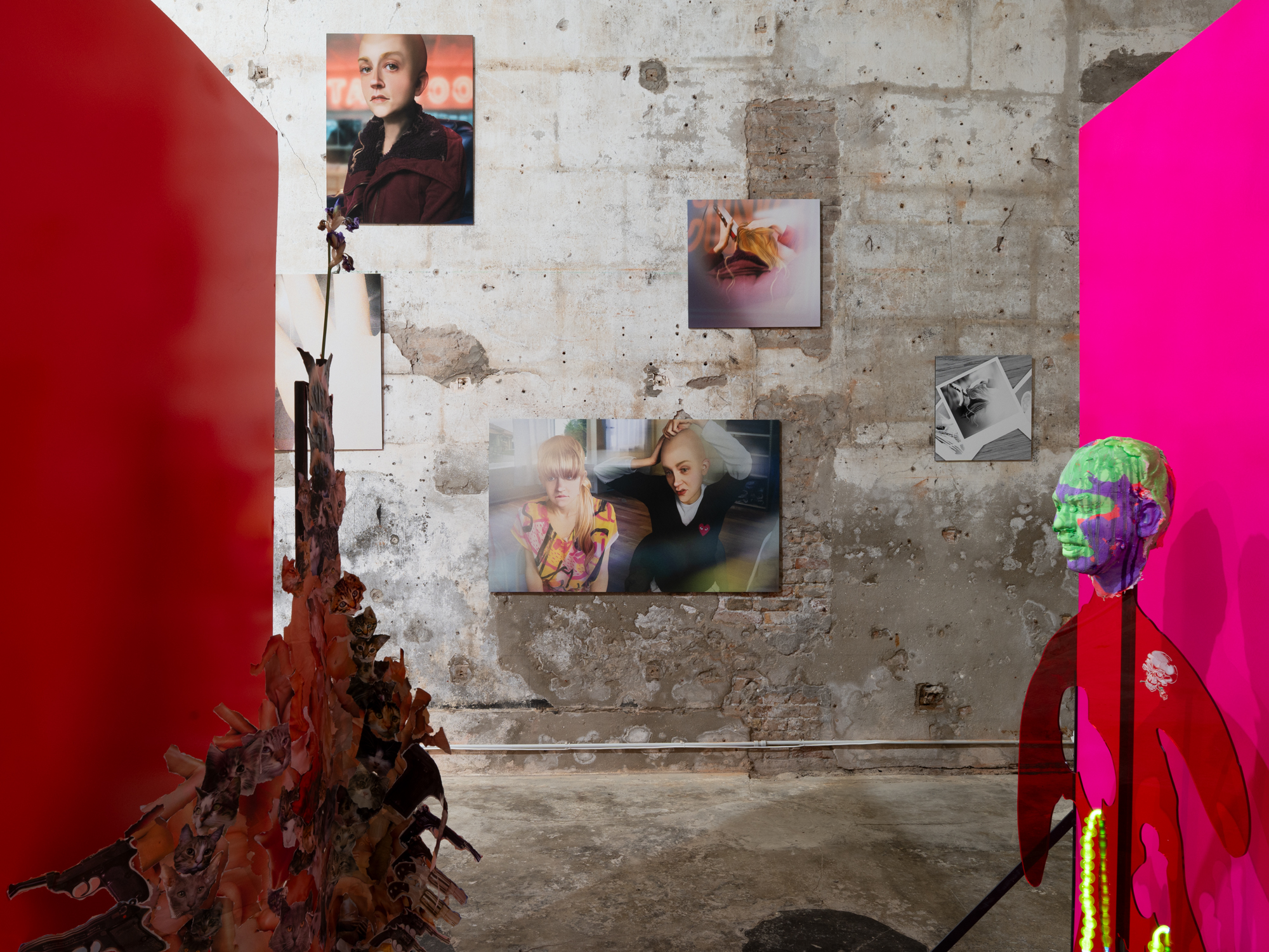
In the late 1970s, the great Argentine artist Marta Minujín (Buenos Aires, 1943, where she lives and works) conceived a series of ambitious, large-scale projects for mass public participation titled La caída de los mitos [The Fall of Universal Myths]. El Obelisco acostado [The Obelisk Lying Down] was first presented at the First Latin American Biennial of São Paulo in 1978, at the height of the military dictatorship in Argentina. With irony, subtlety and humour, Minujín poignantly toppled this urban icon of Buenos Aires, which appeared hollow and manifestly open for people to walk through, effecting utopic, horizontal change in the realm of the symbolic. The exhibition also presents El Partenón de libros [The Parthenon of Books], realised for the first time on December 10, 1983, the date when Argentina celebrated the return of democracy. Here, Minujín reconstructed the Greek temple using thousands of books that had been banned during the dictatorship. At the end of the project, she tilted the structure and encouraged the public distribution of the previously-censored books. Finally, also present in this exhibition is Estatua de la Libertad caída [The Statue of Liberty Falling Down], also conceived in the 1970s but to date an unrealised project. Aside from questioning the sacralisation of the monument and the myth of American freedom, the project takes on a prophetic meaning in light of recent attacks on democratic symbols, principles, and institutions in several parts of the world.
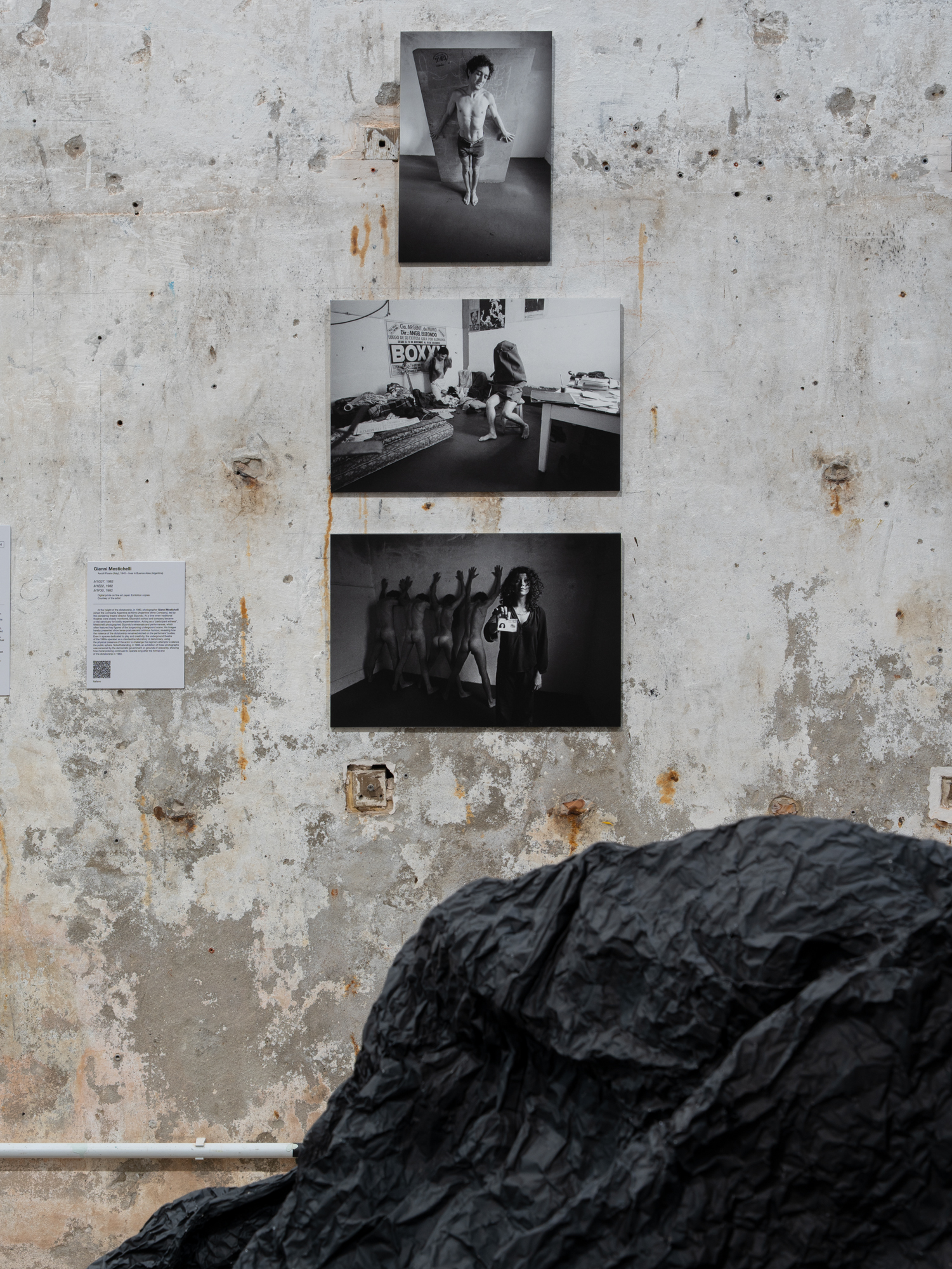
Also at the height of the dictatorship, in 1980, photographer Gianni Mestichelli (Ascoli Piceno, Italy, 1945; lives and works in Buenos Aires) joined the Argentine Mime Company (Compañía Argentina de Mimo), led by the pioneering theatre director Ángel Elizondo (1932–2022). At a time when traditional theatres were closely monitored, Elizondo’s school and company became a vital sanctuary for bodily experimentation, where gesture and silence functioned as powerful tools for expression and political resistance against censorship and repression. Acting as a “participant witness”, Mestichelli photographed Elizondo’s rehearsals and performances, which often featured key figures of the burgeoning underground scene. Mestichelli’s images in Darkness Visible show tense postures and ominous humour, revealing how the violence of the dictatorship remained etched on the performers’ bodies. Even in spaces dedicated to play and creativity, the underground theatre of the 1980s operated as a clandestine laboratory of democracy, using the physical presence of the actor to challenge the regime’s attempts to silence the public sphere. But there was another chapter in the political dimension of Mestichelli’s work after democracy was formally restored in 1983. In 1986, an exhibition of these photographs was censored by the democratic government on grounds of obscenity. This paradox exposed the lingering fragility of the new democratic era and demonstrated how State-sanctioned violence and moral policing continued to operate long after the formal end of the dictatorship in 1983.
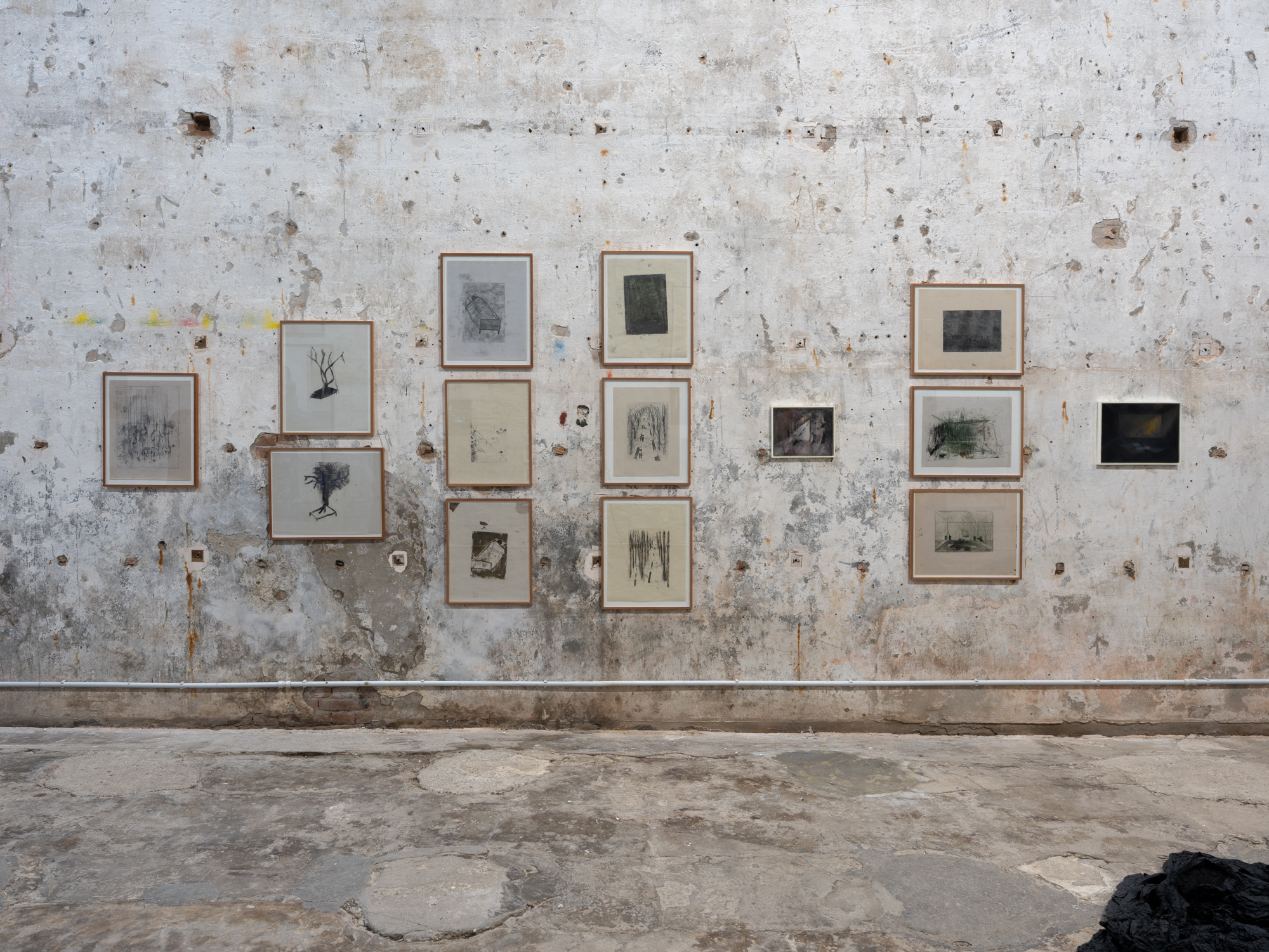
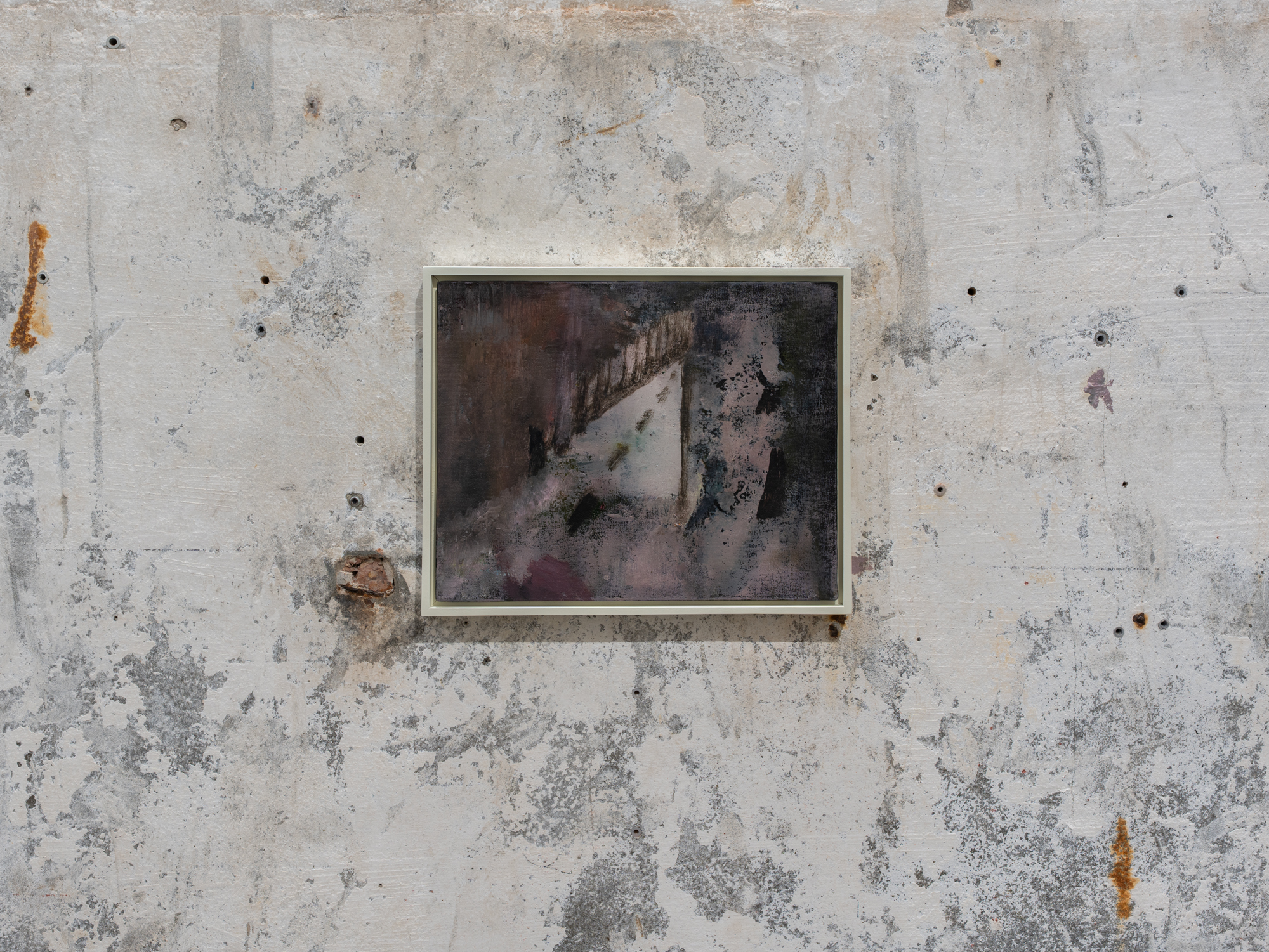
Theatre has indeed played a critical role in deepening our understanding of the lasting damage to humanity of a politics of violence, and is a critical locus explored by artists of the most diverse disciplines, alongside a practice of multidisciplinarity that is a trait of Argentine contemporary culture. Working in the liminal space between visual arts and theatre, Guillermo Kuitca (Buenos Aires, 1961, where he lives and works) has produced a recent set of drawings that expand our capacity for empathy towards human pain and suffering. At each drawing, the protagonist-viewer is invited to inhabit an interior space. Some bear the marks of seething human energies past; others allow the viewer to embrace solitary sleeping figures; still others let the viewer roam through cold, damp forests, where just abandoned chairs stand in orderly rows; one final drawing of empty chairs and objects suspended from the ceiling in disarray conjures some grand tragic finale. Each scene does not merely represent the pain of humanity; every image aches with the agony of individual and social subjectivities past and present. These beautiful, austere drawings address a Freudian question: In what does the work performed by mourning now consist? These are performative drawings capable of eliciting a seismic psychological disruption in the viewer. Standing before them, we become actors in – or witnesses to – a drama that is alive with actual lived experience. But Kuitca goes still further, displaying a unique ability to conjoin subjective experience, spatial thought, and political reflection, with trauma at its structural core. As early as 1980, at the age of just 19, Kuitca created the visionary painting Del 1 al 30.000 [From 1 to 30,000]. Every last one of these numbers was drawn on the canvas consecutively, echoing the symbolic number that diverse human rights organisations had begun to give as the total of Argentina´s disappeared under its military dictatorship.
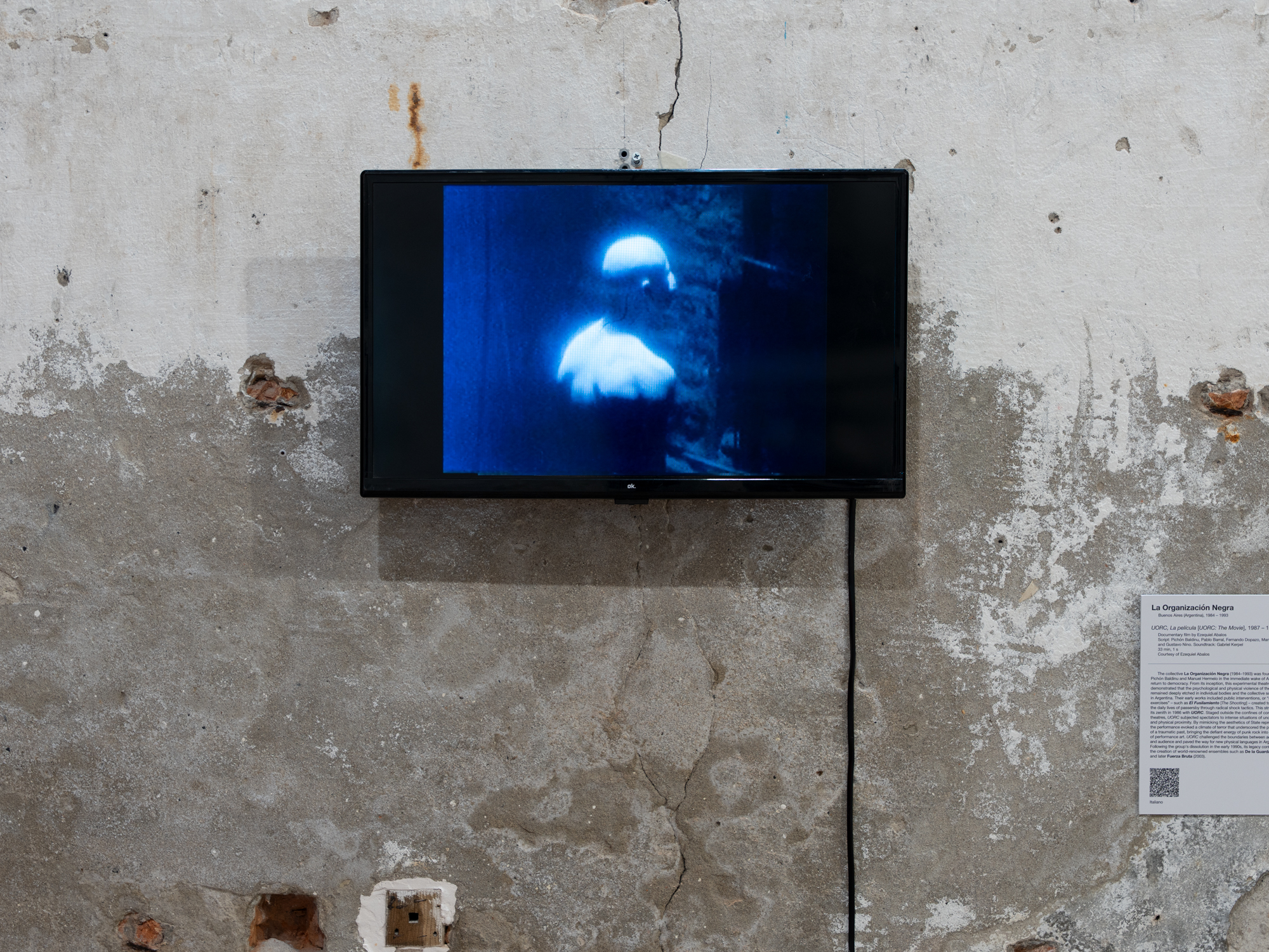
The collective La Organización Negra (1984–1993) was founded by Pichón Baldinu and Manuel Hermelo in the immediate wake of Argentina’s return to democracy. From its inception, this experimental theatre group demonstrated that the psychological and physical violence of the dictatorship remained deeply etched in individual bodies and the collective social memory in Argentina. Their early works included public interventions, or “guerrilla exercises” – such as El Fusilamiento [The Shooting] – created to disrupt the daily lives of passersby through radical shock tactics. This strategy reached its zenith in 1986 with UORC. Staged outside the confines of conventional theatres, UORC subjected spectators to intense situations of uncertainty and physical proximity. By mimicking the aesthetics of State repression, the performance evoked a climate of terror that underscored the persistence of a traumatic past, bringing the defiant energy of punk rock into the realm of performance art. The radical experimentation of UORC challenged the boundaries between actor and audience and paved the way for new physical languages in Argentine theatre. Following the group’s dissolution in the early 1990s, its legacy continued through the creation of world-renowned ensembles such as De la Guarda (1992) and later Fuerza Bruta (2003).
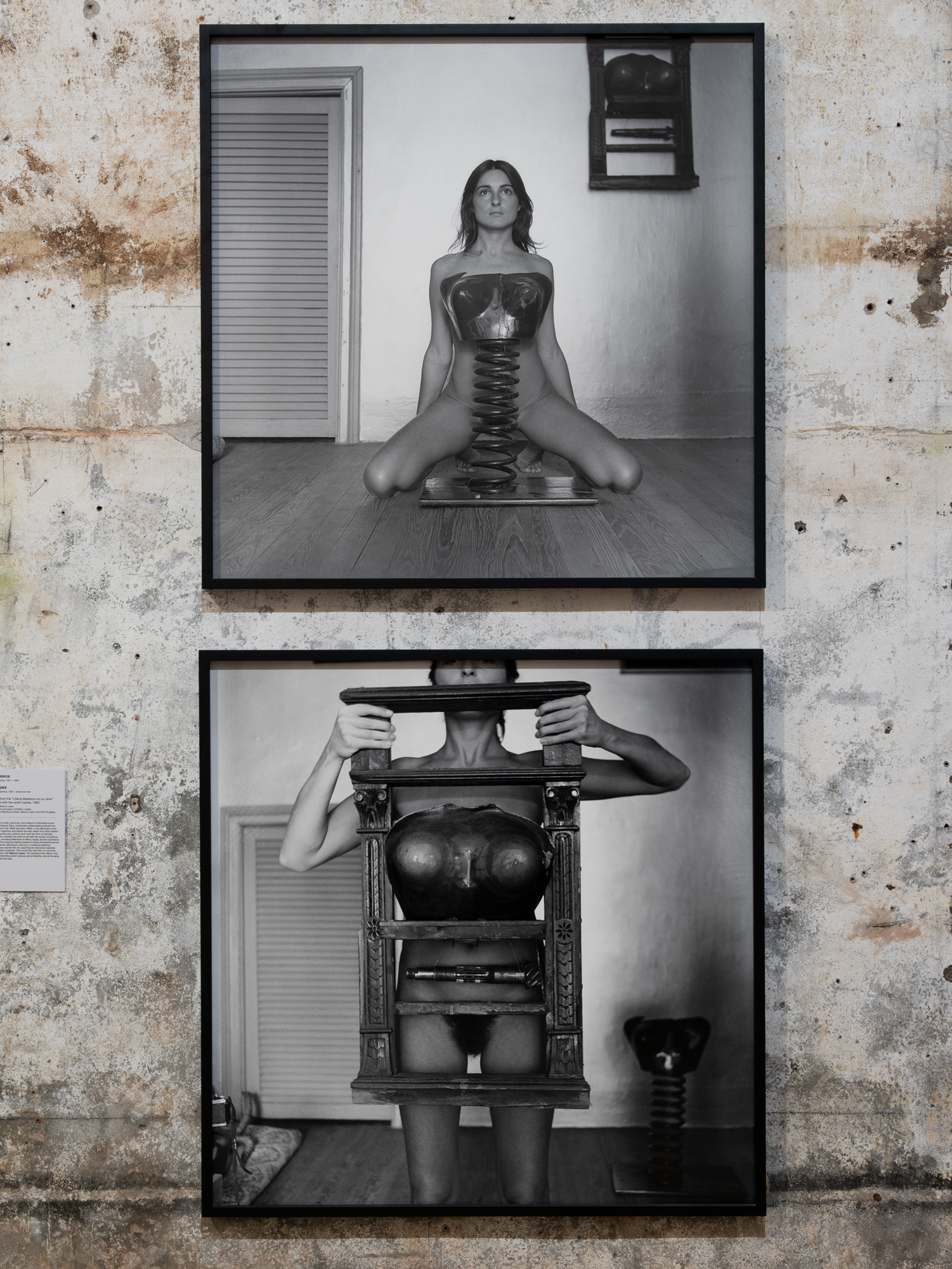
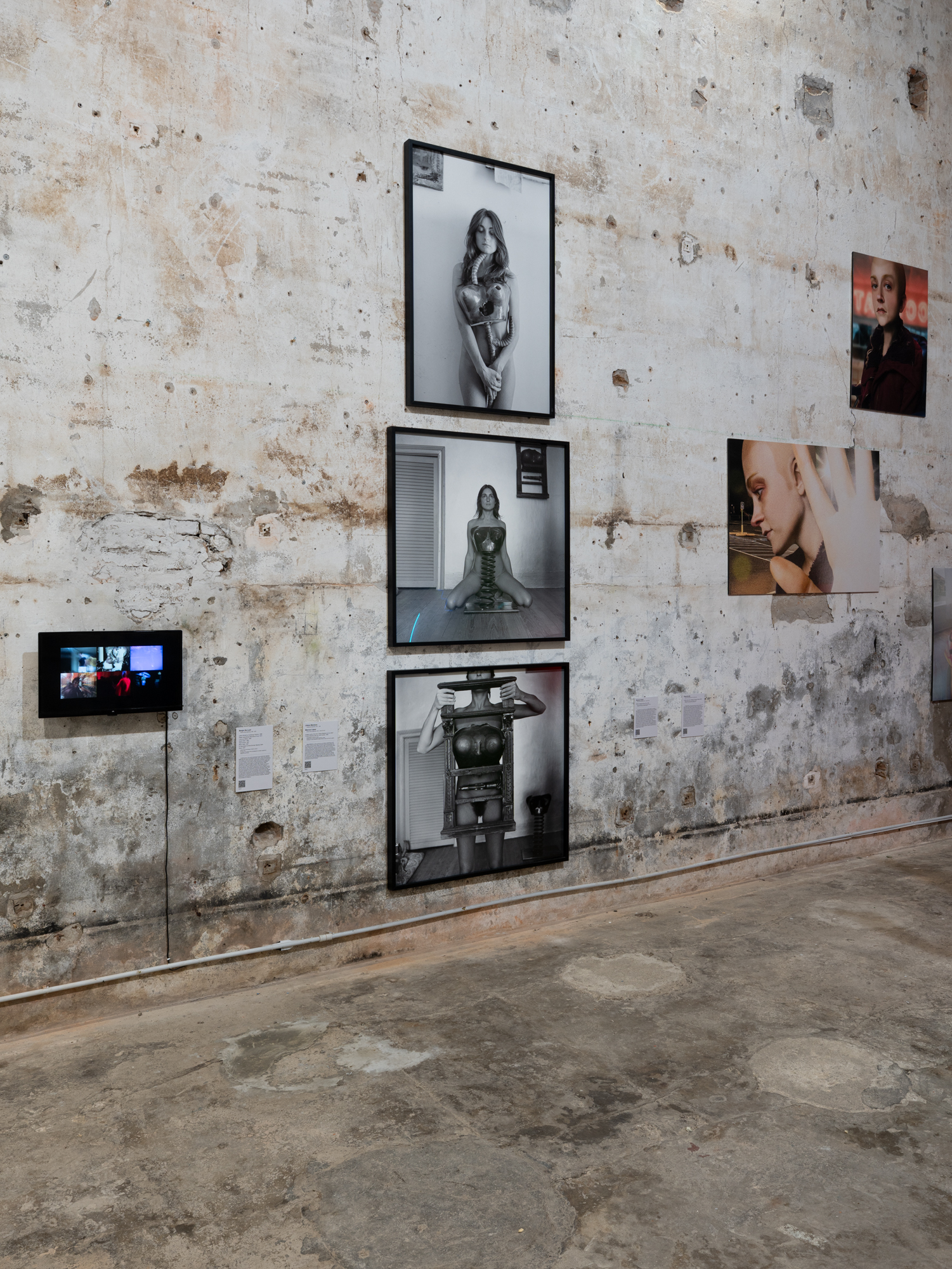
Liliana Maresca (Buenos Aires, 1951-1994), an artist, performer, and catalyst of alternative social circuits acting at the crossroads of diverse artistic – circuits in Buenos Aires – visual arts, theatre, music, dance and literature – introduced a desacralizing attitude into the Buenos Aires underground scene during the 1980s and early 1990s, in the aftermath of the military dictatorship in Argentina and before her early death from AIDS-related causes in 1994. Her profoundly political work took the form of intimate, existentialist statements, whereby the artist would defy the social conventions of a fundamentally conservative time, provoking reflections on ethics, equity, and the importance of the spiritual in art in order to confront the tense atmosphere that resulted from the traumatic years of the dictatorship and the continuing subtle, structural psychological violence still exerted on women and LGBTQ+ communities in Argentina. The sculptural objects present in her photoperformances literally constrain her body, attacking it, piercing it, hindering breathing and movement. Maresca roamed the city searching for discarded materials with which to build these sculptures. She would then test them on her body in a photography session with Marcos López (Santa Fe, Argentina, 1958; lives and works in Buenos Aires). The resulting work offers a key to Argentina’s post-dictatorship period: sensual, almost libertine, and at the same time marked by fracture and pain. In the artist´s words, “[i]t was a happy time, a time of great enthusiasm about our art. We were going to change the world. We were setting all that vitality against a society that produced dead people, repressed misshapen people. We lived in fear, you had to be brave to live and to show your work.”
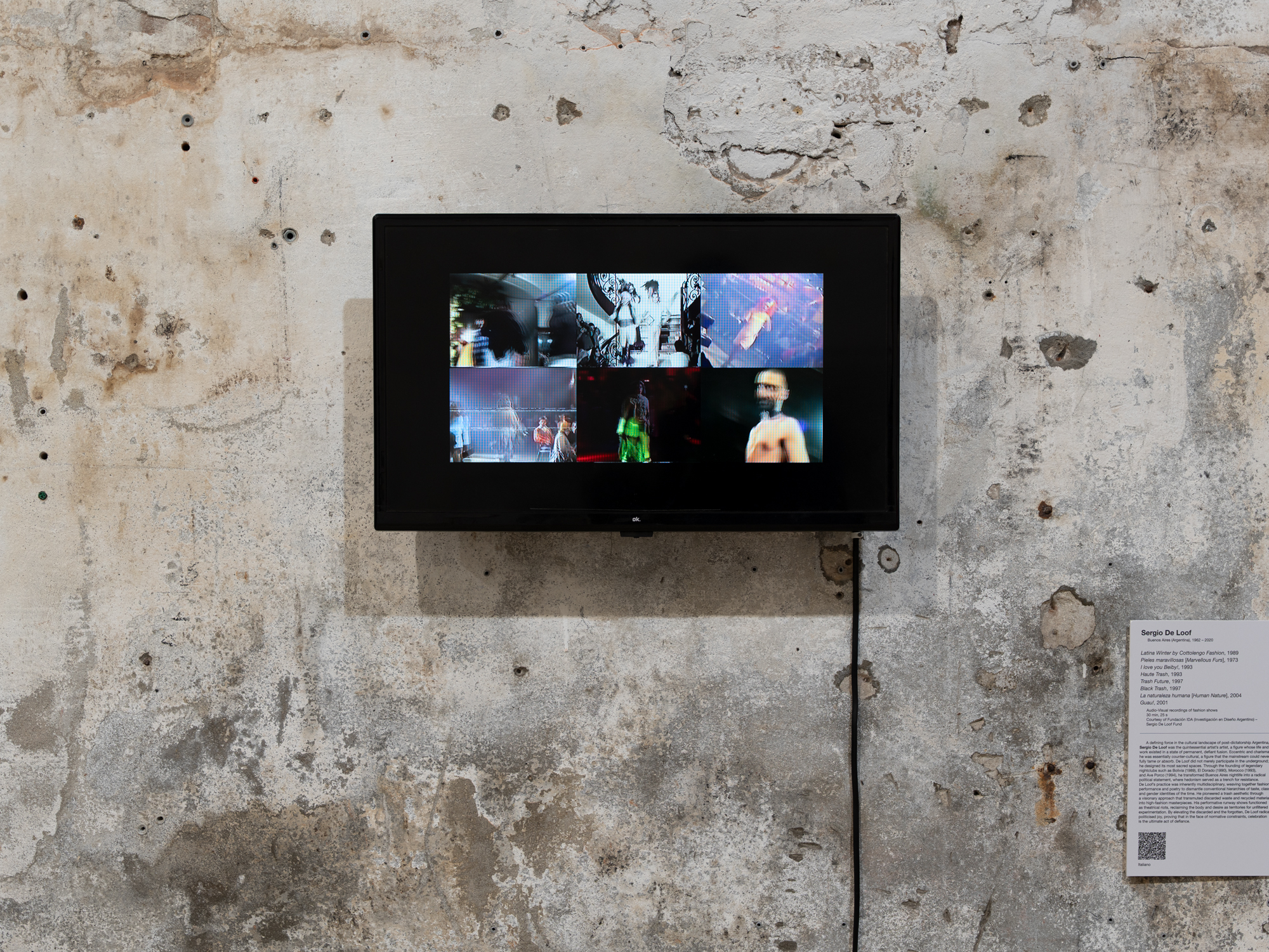
A defining force in the cultural landscape of post-dictatorship Argentina, Sergio De Loof (Buenos Aires, 1962-2020) was the quintessential artist’s artist, a figure whose life and work existed in a state of permanent, defiant fusion. Eccentric and charismatic, he was essentially counter-cultural, a figure that the mainstream could never fully tame or absorb. De Loof did not merely participate in the underground; he designed its most sacred spaces. Through the founding of legendary nightclubs such as Bolivia (1989), El Dorado (1990), and Ave Porco (1994), he transformed Buenos Aires nightlife into a radical political statement, where hedonism served as a trench for resistance. De Loof’s practice was inherently multidisciplinary, weaving together fashion, performance, photography and poetry to dismantle conventional hierarchies of taste and class and the sexual orientation and gender identity of the time. He pioneered a trash aesthetic through a visionary approach that transmuted discarded waste and recycle materials into high-fashion masterpieces. These were not simply garments; they were the vestments of a new sociability. His performative runway shows functioned as theatrical riots, reclaiming the body, gender and desire as territories for unfiltered experimentation. By centring the marginal and the dissident, De Loof turned the nightclub into a queer laboratory. In his world, there were no boundaries between the social and the artistic; to exist was to create. By elevating the discarded and the forgotten, he radically politicised joy, proving that in the face of normative constraints, celebration is the ultimate act of defiance.
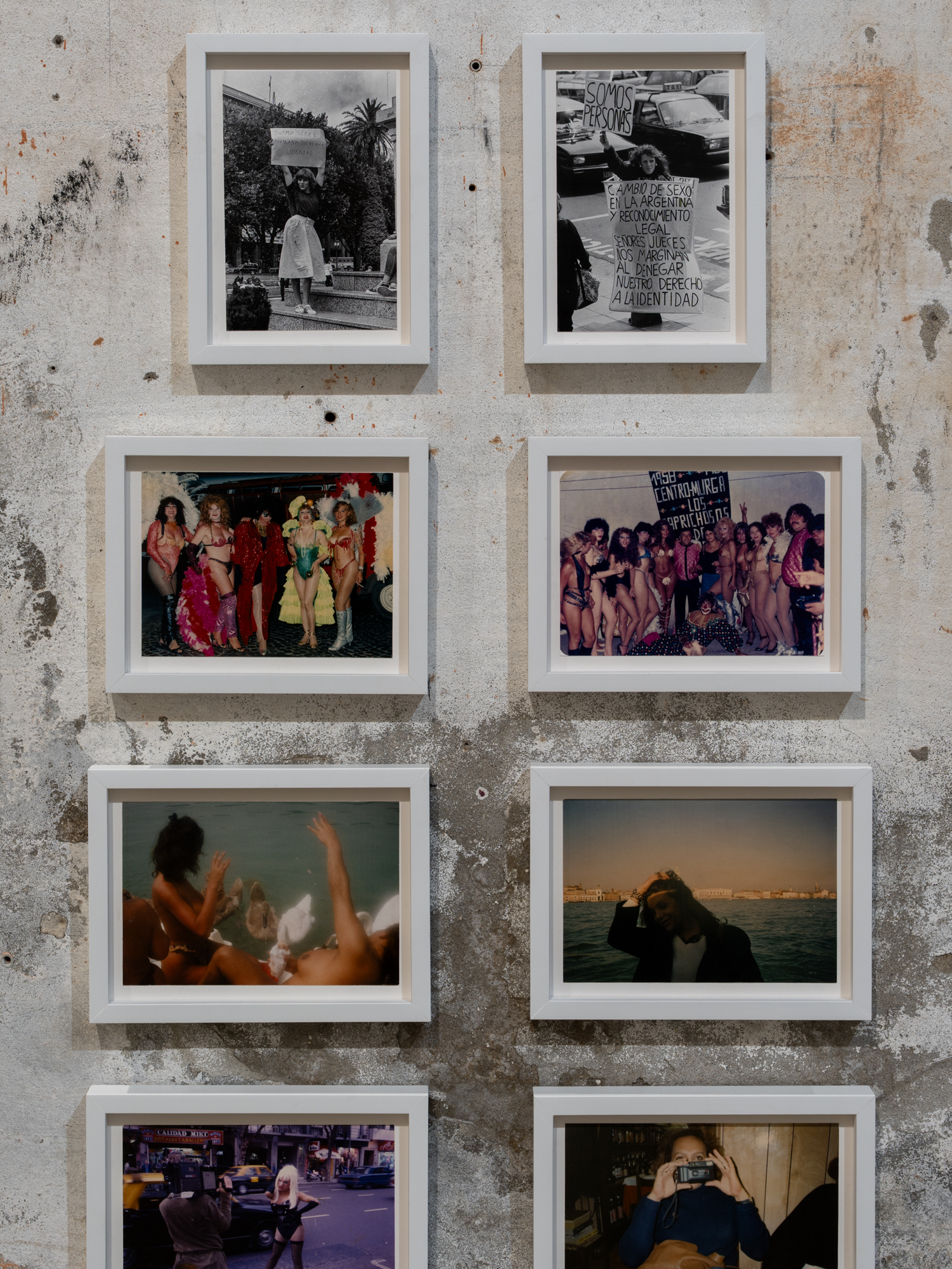
The history of Argentina’s trans-travesti community – shaped by systematic marginalisation, State violence, and social exclusion – has become one of the central focuses of the community memory work carried out by the Archivo de la Memoria Trans (AMT). Founded in 2012 by María Belén Correa, following a long-held vision she had nurtured alongside her fellow trans activist Claudia Pía Baudracco, the Archive began with personal photographs documenting lives shaped by affection, solidarity, and survival, especially in the 1980s and 1990s, when police orders were systematically used to persecute and control the presence of these communities in public spaces. In 2014, together with visual artist Cecilia Estalles, a formal process of collection and preservation was established to safeguard the Archive. The images gathered by the Archive document the continuity of State violence against trans bodies and the forced exile many experienced even after the end of the last military dictatorship in 1983, challenging the historic notion of a clean return to democracy. It took two decades of political organisation for the Gender Identity Law to pass in 2012, to enable the institutional recognition of trans persons as legitimate citizens according to their self-perceived gender. Darkness Visible includes a selection of photographs from the AMT from the 1970s onwards. Amongst them, Baudracco poses before iconic Buenos Aires landmarks such as the Teatro Colón and the National Congress, turning experiences of terror – such as the Ford Falcon car associated with clandestine kidnappings during the dictatorship – into one of defiant presence. By painstakingly collecting, preserving, cataloguing and exhibiting over 30,000 photographs and documents, the Archivo de la Memoria Trans stands up to the erasure of identities, memory and history of the trans-travesti community in Argentina, transforming records of intimate beauty, early public manifestations, festive spaces such as carnivals, and pictures taken in exile, into affective devices that challenge official narratives.
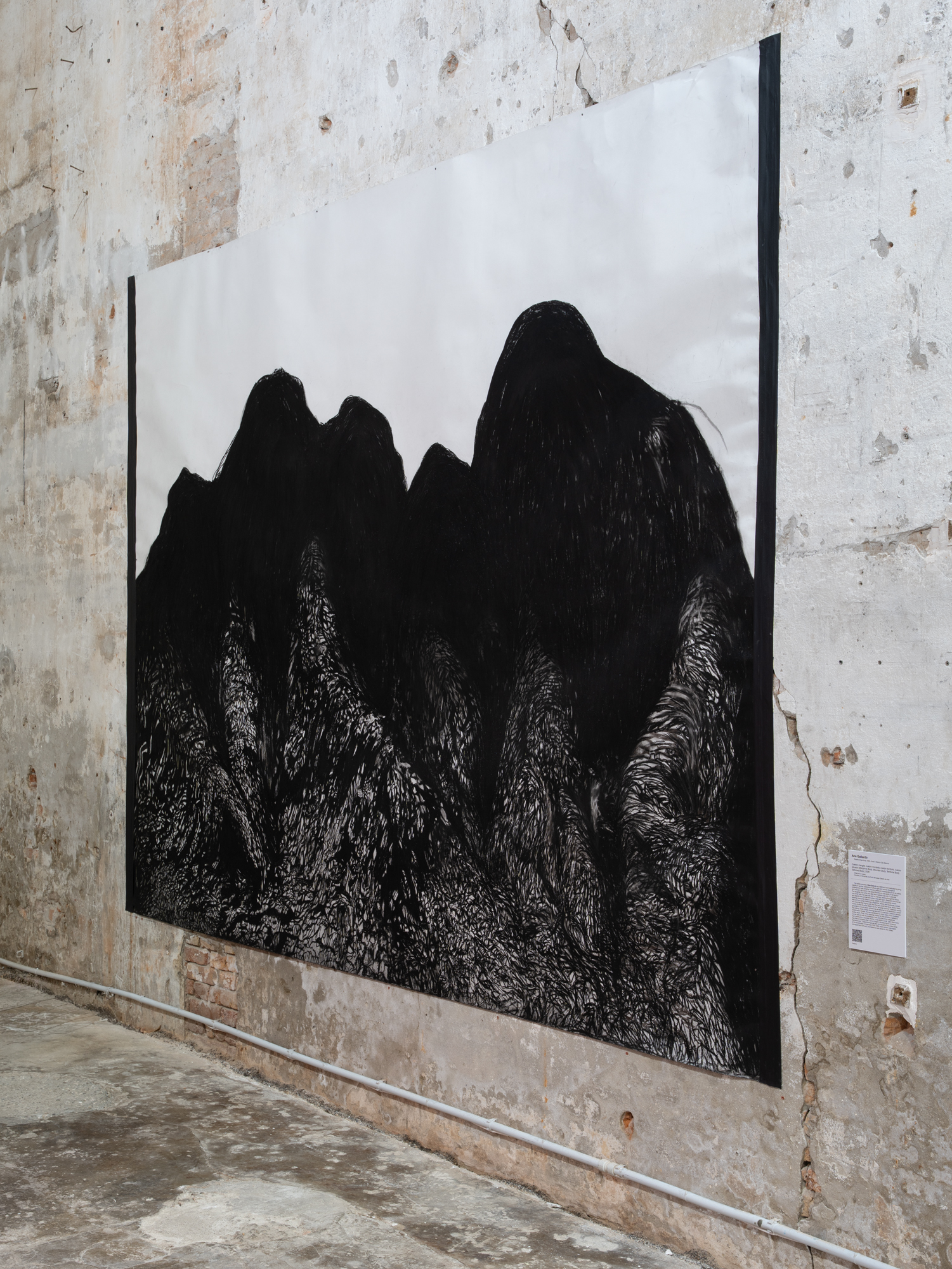
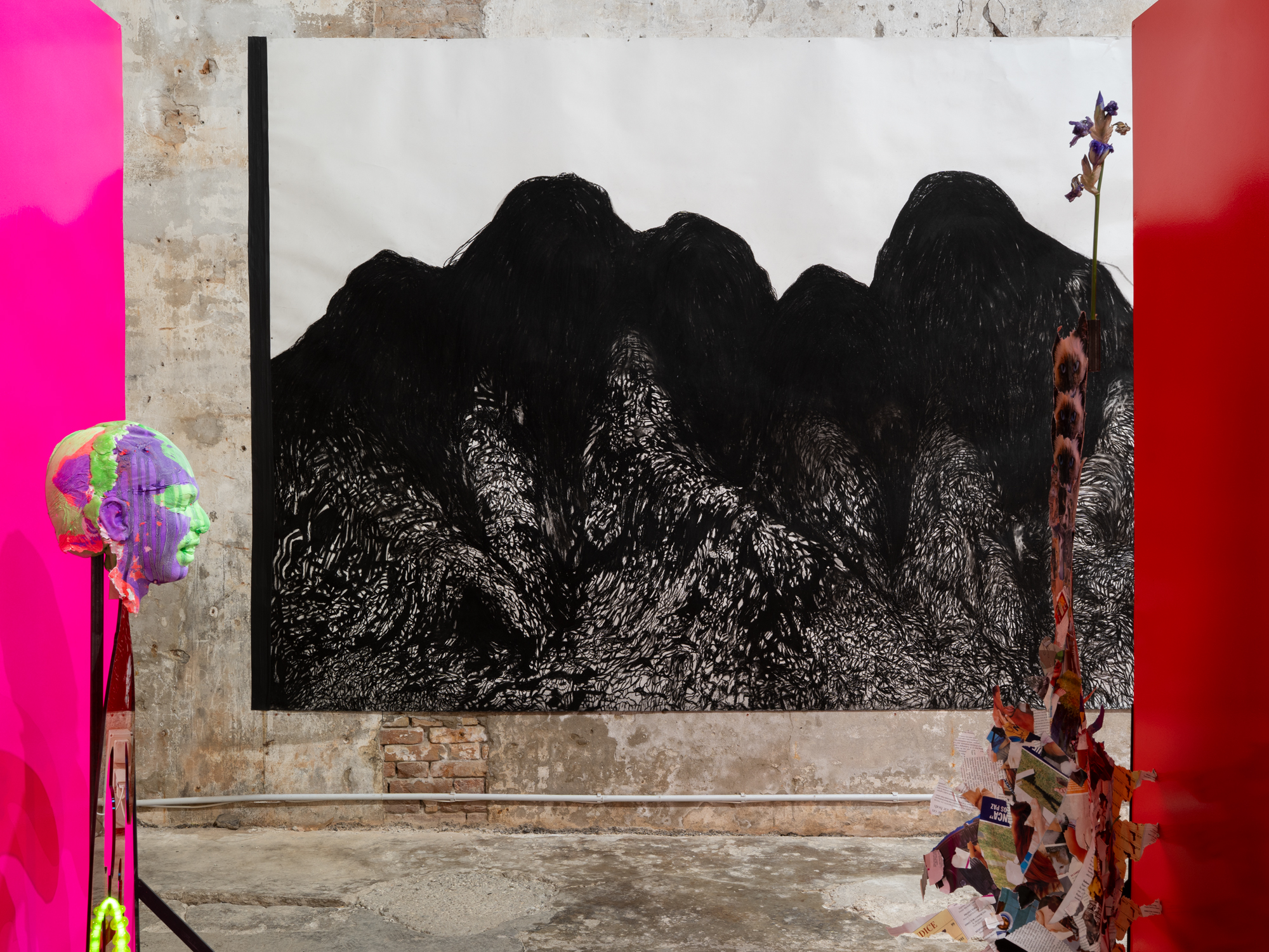
The artistic practice of Ana Gallardo (Buenos Aires, 1958, lives and works in Mexico City) is a lifetime of work dedicated to giving visibility to gender violence as it affects girls and women throughout contemporary Latin America. Hers is a profound understanding of art as politics and activism, as a tool to “talk about the thing no one wants to talk about.” The daughter of an artist who died when Gallardo was only 7 years old, one of her traits has been her work on memory, working through the traces and objects that survived her mother. Time and again, Gallardo’s monumental drawings denounce violence, giving visibility to girls and young women rescued from human trafficking in Argentina, Mexico and Guatemala, women who have lost their dignity and, thus shamed, cover their faces. Alive or dead, victims of what the artist refers to as the “femicide machine”, these are women grounded in a local history, whose lives are attached to the territories to which they belong. Most of these drawings are done in charcoal, a material claiming rootedness in the soil, the same landscape to which many of the murdered bodies return. Thus, in the drawings created for Darkness Visible, Gallardo’s women are one with the landscape, their arms becoming mangroves, their community a mountain skyline. In the artist’s words, “[as] I draw them, the charcoal dictates what I cannot forget, it dictates how to construct the landscape.” These drawings are also reminiscent of the violent times of the dictatorship in Argentina (1976-1983) when women were raped, kidnapped and tortured, and treated as sex slaves by the military.
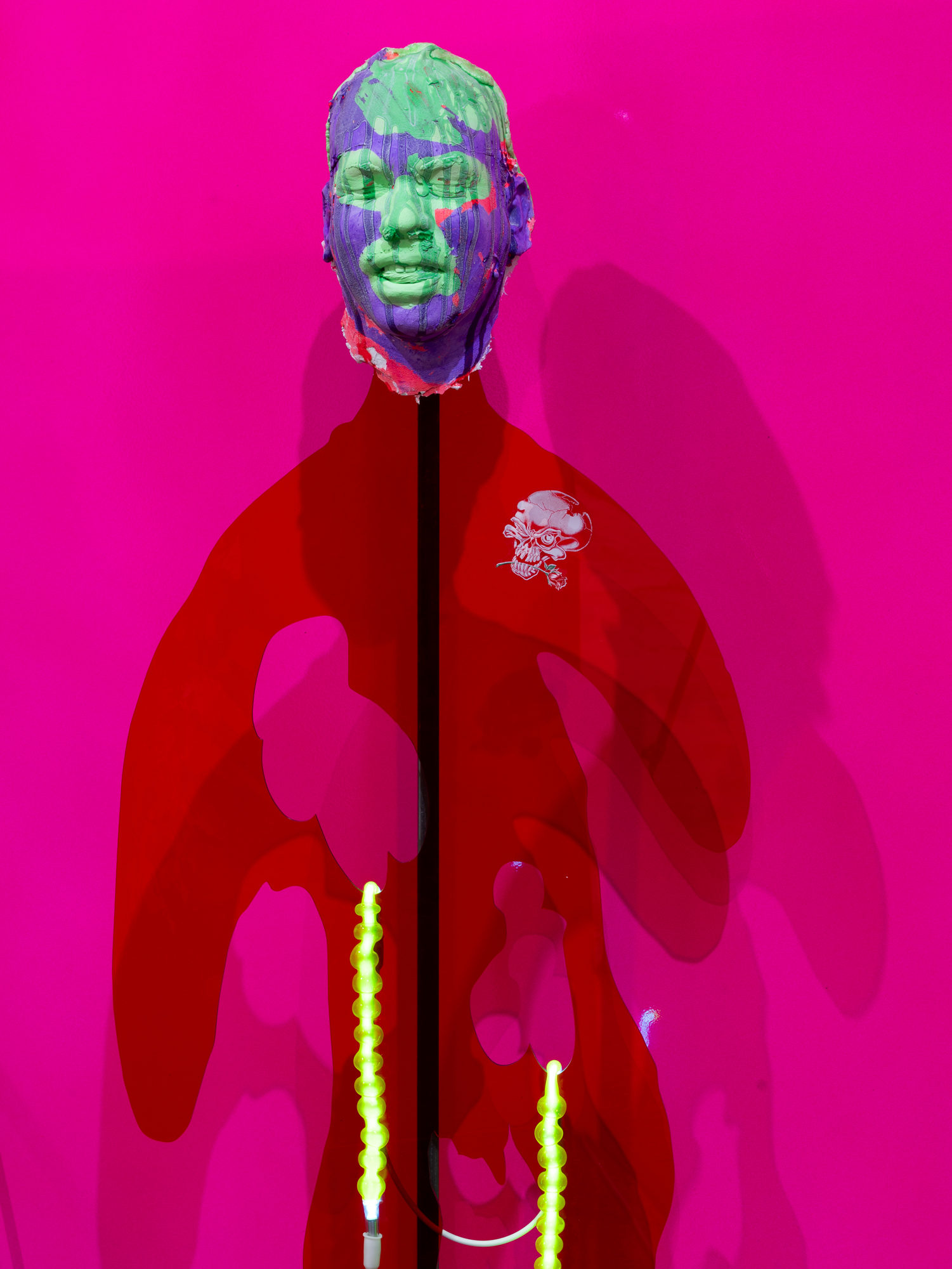
In the dazzling, liminal sculptural work of Nicanor Aráoz (Buenos Aires, 1981, where he lives and works) two clashing drives coalesce. On the one hand, a fervent belief in the power of art to materialise hallucinatory visions and desires, both for himself and for humanity. On the other, an understanding of art as exorcism, as a vehicle to allow for existential trauma to find a place where healing may perhaps take place. For this exhibition, Aráoz has chosen to create Glótica 3 (Argentina Brava Mix), a new work reminiscent of the Stations of the Cross in which the artist himself for the first time appears. Unlike previous versions of Glótica dated 2015, here the figures are whole, less dismembered, less torn. They are able to speak out. Each figure stands against a fluorescent panel, where we visualise ripped-up architectures, the divided States of the world. Araóz stages what critic Alejo Ponce de León has described as “an intense display of reality,” as the artist allows himself to process and address his mother’s brutal femicide, and the repressive traits and violence exerted by his father – a Malvinas War veteran who survived the sinking of the Belgrano. Glótica 3 is, notwithstanding the tragedies involved, a celebration of art: of its capacity to process tension, to cry and denounce, to explore matter and desire, to investigate life and death, eroticism and crime, madness and reason, and to do so while keeping close to the artist’s loves: the spectacles of fashion, cyberpunk, camp and the rhythms and beats of electronic music.
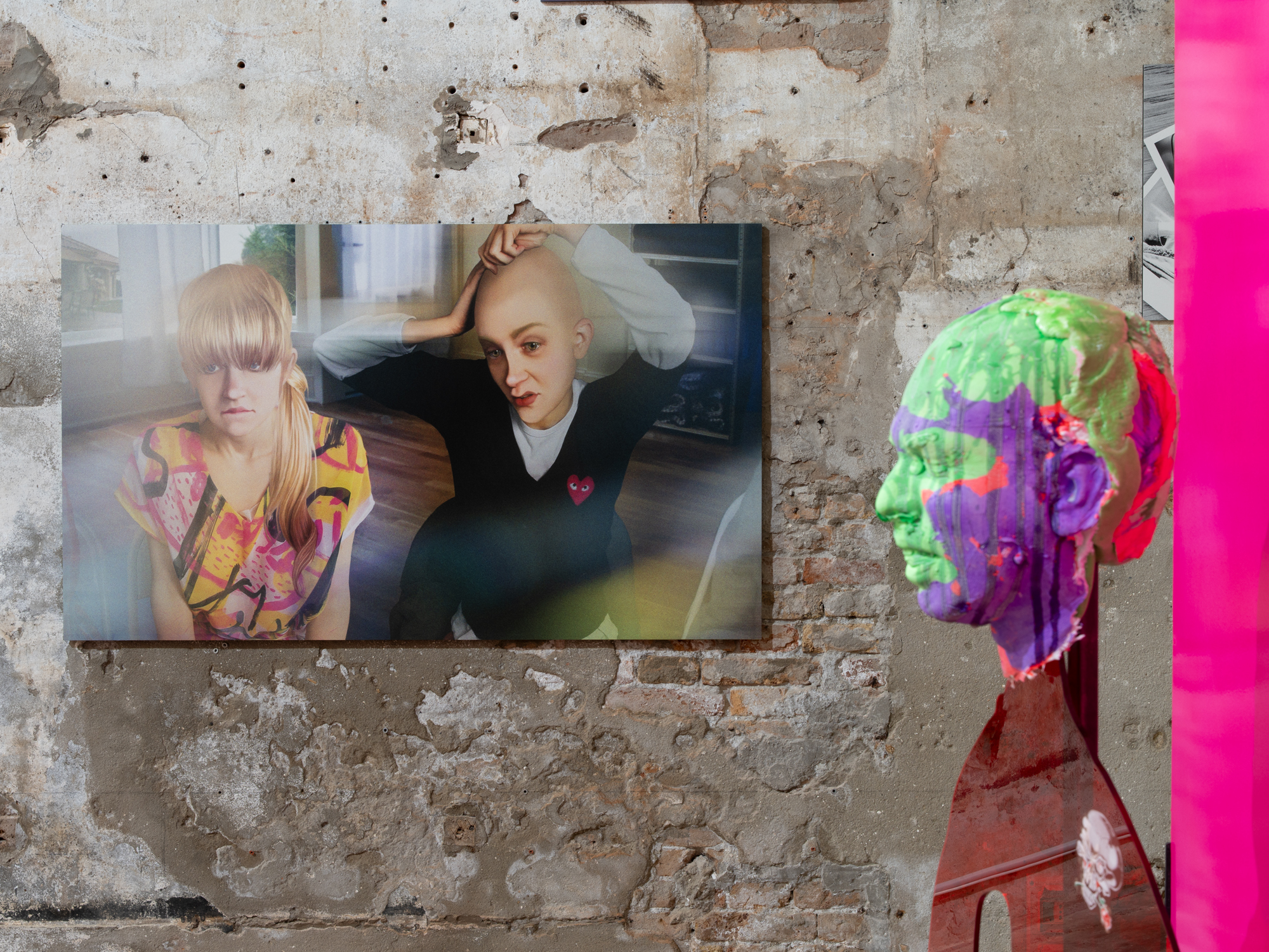
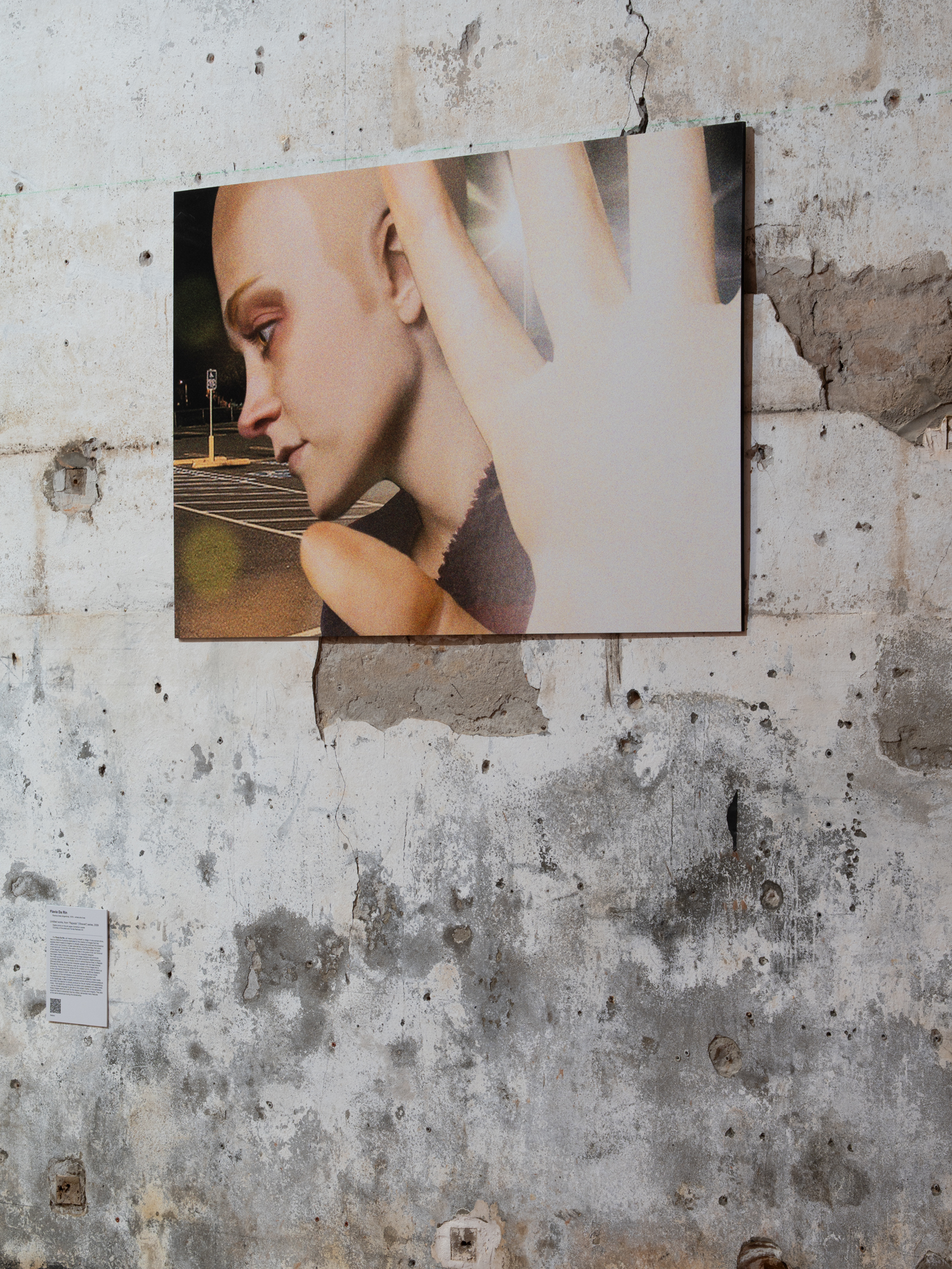
For Flavia Da Rin (Buenos Aires, 1978, where she lives and works), art means putting herself on stage. A one-woman show, hers is a lifetime of practice dedicated to the creation of images that fully express what it means to imagine: to critically observe the world and the dynamics within which we function, to seek alternatives, including fantasy, from one’s innermost truth. To do this, she walks a fine line: the initial subject of each of her staged photographs, she quickly hides in the guise of her own fictional characters. Flavia is thus the scriptwriter, the character-designer, the image-maker, the props, costume and stage designer and producer, the make-up artist, the photographer, the post-production digital producer, a process taking place in her studio home in central Buenos Aires. In Rapada [Shaved] (2009), the artist-turned-character appears with her head shaved. She sets the viewer at a distance, even as a voyeur of the images she is producing. This is one of the series Da Rin created out of a need to stand up to the commercial pressures of the art world: to say “basta” to the infinite demand for those images that easily attract, and sell, and which constantly distract the artist from her own necessity to create in freedom. Inspired by Britney Spears’s radical headshave in 2007, this series operates on at least four levels: the rejection of the normalisation of womanhood as associated with the stereotypical image of commercial femininity as fuelled by mass media in the digital age; a deep empathy towards women enduring extreme pressure and crisis – “I always feel great empathy with those situations. The sadness and solitude of it;” the rejection to blindly produce for the art market; and establishing noise – that digital blur quoting the circulation and oppression of mass media – as the chosen language to give life to her subject matter. In this exhibition, these images stand as a call for the respect of privacy and integrity. They also recall the need to remember that the military demanded many features of the same stereotype during the dictatorship.
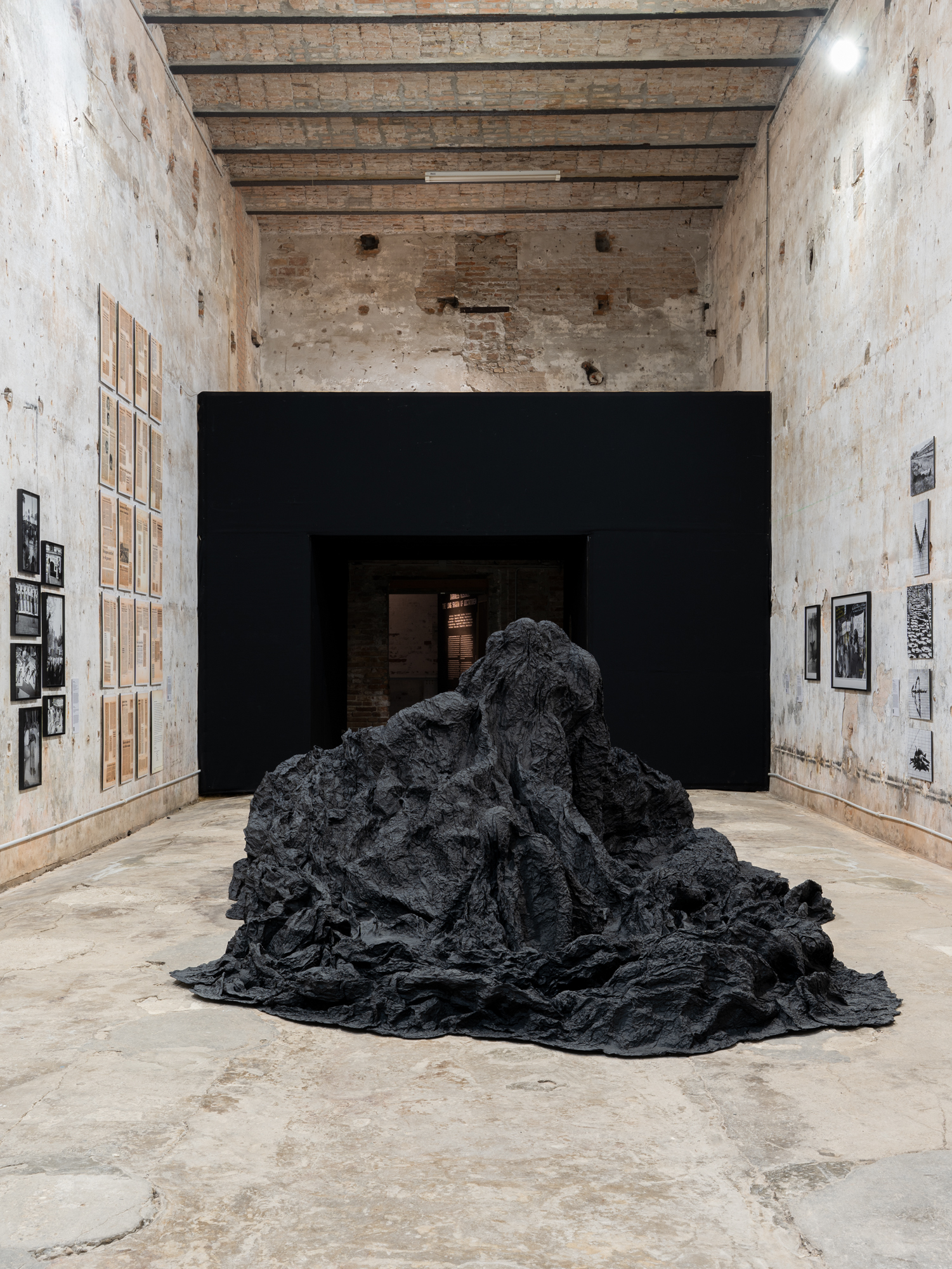
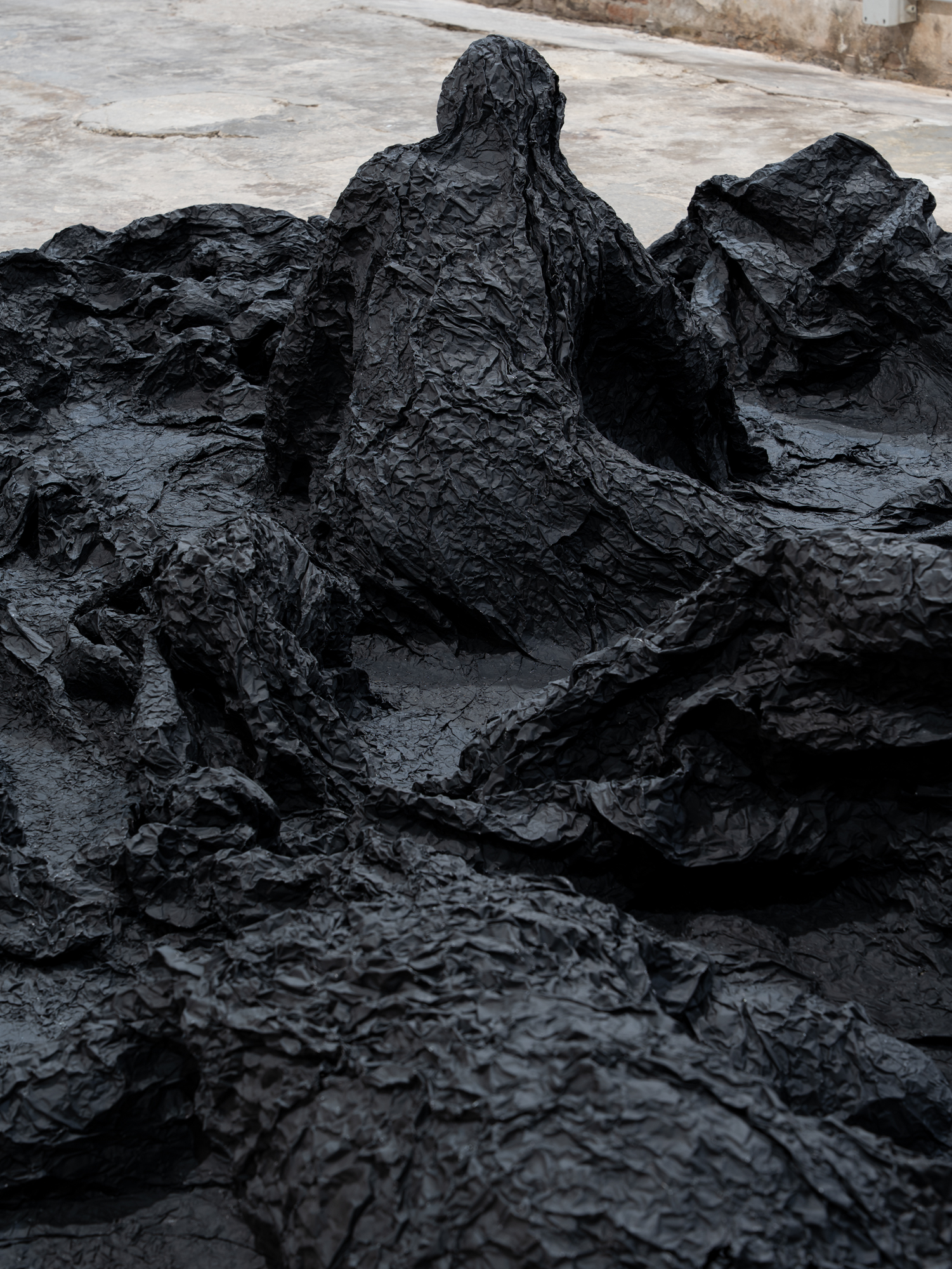
Eduardo Basualdo (Buenos Aires, 1977, where he lives and works) was born in the winter of 1977, at the height of the military dictatorship’s brutal repression. This climate of sometimes ostensible, sometimes insidious threat, intertwined with the primordial fears rooted in childhood, could have left a mark on his work, populated by hidden presences and uncontrollable forces. In this work, Basualdo employs black foil to sculpt a group of living figures in flight. By shaping it directly, pressed and moulded, onto the bodies, the material registers their movement and gestures before the bodies are withdrawn, leaving a hollowed shell behind. At once light and resistant, fragile yet capable of preserving form, the sculpture rises as a tense boundary between presence and absence, representation and loss. The figures remain suspended in a condition of unstable balance, their forms held between formation and collapse. Do they mark the emergence of a community, or the trace of its disappearance? Are these the ruins of a recent tragedy, or the early stirrings of a nascent reanimation?
Darkness Visible opens up a field of tension in which traces of loss become the condition to imagine those ideas and projects that may still come into being. The artists in the exhibition confront the long shadow of violence and repression cast by Argentina’s last military dictatorship (1976–1983). They deploy radical aesthetic strategies that seek to record, denounce and transform the trauma into a cry of shared protest. The works assembled here articulate a politics of memory grounded in tenacity sustained by the conviction that what has been erased continues to shape our modes of attention, responsibility and the basic terms of common life. Though anchored in the specific history of Argentina’s last dictatorship, the exhibition speaks to a broader global condition, one in which democratic institutions are once again under strain, and forms of violence, both overt and covert, continue to mould our world. In the face of such resurgent threats, these works urge us to remember. They steer us toward what is left to imagine and re-open the question of what democracy might yet become. What promises still lie on the democratic horizon? What forms of life, justice and collective imagination are yet to be accomplished?
1 León Ferrari, “Nosotros no sabíamos” (1976/1992), 1. The complete set of collages can be accessed at https://leonferrari.com.ar/nosotros-no-sabiamos.
2 León Ferrari, as quoted in El Siluetazo, Ana Longoni and Gustavo Bruzzone (eds.) (Buenos Aires: Adriana Hidalgo, 2008), p. 43.
3 See Gavin Delahunty in Psychic Wounds: On Art & Trauma (Dallas: The Warehouse & New York: MW Editions, 2021), p.12.
4 Liliana Maresca’s manuscripts quoted by Javier Villa in the essay “Forma = Determinación. Liliana Maresca 1982-1994.” In: Liliana Maresca (Buenos Aires: Museo de Arte Moderno de Buenos Aires, 2016), p. 47.
5 Interview with Gabriela Cabezón Cámara. In: Ana Gallardo: Un lugar para vivir cuando seamos viejos (Buenos Aires: Museo de Arte Moderno de Buenos Aires, 2015), p.34.
6 Ana Gallardo in conversation with Victoria Noorthoorn, April 4, 2026, Buenos Aires.
7 Interviewed in: “Fragments of a Conversation between Diana Aisenberg, Flavia Da Rin and Guillermo Kuitca.” In: Flavia Da Rin ¿Quién es esa chica? (Buenos Aires; Museo de Arte Moderno de Buenos Aires, 2019), p. 189.
Institutional Background
The selection of works brought together under the exhibition Darkness Visible: The Long Shadow of Dictatorship arise out of a sustained curatorial conversation that long predates the project. It draws on artists studied, exhibited, collected and accompanied by the Museo Moderno for many years – artists who have shaped some of its most defining and vibrant exhibitions. As our institution prepared for its 70th Anniversary in 2026, this continuity opened up a space for the Museum to look back on its own history and trace the aesthetic strategies vital to sustaining creative imagination and freedom of expression as forces central to human development. Rooted in the Moderno’s engagement with history and memory, the exhibition foregrounds their urgent and ongoing relevance in the present.
Artists: León Ferrari (Buenos Aires, 1920), Marcelo Brodsky (Buenos Aires, 1954), Luis Pazos (La Plata, 1940–2023), Luis Camnitzer (Lübeck, Alemania, 1937), Marta Minujín (Buenos Aires, 1943), Eduardo Gil (Buenos Aires, 1948), Aldo Sessa (Buenos Aires, 1939), Gianni Mestichelli (Ascoli Piceno, Italy, 1945), Guillermo Kuitca (Buenos Aires, 1961), Liliana Maresca (Avellaneda, 1951–1994) & Marcos López (Santa Fe, 1958), Néstor Perlongher (Avellaneda, 1949 – São Paulo, 1992), La Organización Negra (Buenos Aires, 1984), Sergio De Loof (Buenos Aires, 1962–2020), Archivo de la Memoria Trans (Buenos Aires, 2012), Ana Gallardo (Rosario, 1958), Nicanor Aráoz (Buenos Aires, 1981), Flavia Da Rin (Buenos Aires, 1978) and Eduardo Basualdo (Buenos Aires, 1977).
Curated by: Victoria Noorthoorn, Director of the Museo de Arte Moderno de Buenos Aires and Patricio Orellana, Head of the Curatorial Department of the Museo de Arte Moderno de Buenos Aires, in collaboration with Augusto Maurandi, Creative Director of Spazio Punch.
An exhibition by the Museo de Arte Moderno de Buenos Aires at Spazio Punch
Address: Sestiere Giudecca 800/o, Venice
Exhibition Dates: 6 May – 22 November, 2026
Opening Hours: Wed-Mon 10am – 1pm & 3pm – 7pm. Tuesdays closed.
An exhibition developed by Museo de Arte Moderno de Buenos Aires, a public institution dependent on the Ministry of Culture of the Buenos Aires City Government, as per the invitation of Spazio Punch, Venice, with the support of Museo Moderno´s Friends Association, and sponsored by Adcap Grupo Financiero. The exhibition counts with the generous support, as well of the galleries Barro|Arte Contemporáneo, Kurimanzutto, Ruth Benzacar – Galería de Arte and Rolf Art.