El coraje tan dócil, la bravura tan chirle, la intrepidez tan lenta no me sirve. No me sirve tan fría la osadía. Sí me sirve la vida, que es vida hasta morirse. El corazón alerta sí me sirve.
Such docile courage, such insipid bravery, such unhurried intrepedity is of no use to me. Such ice-cold daring is of no use to me. What is useful is life, which is life until death. A watchful heart is of use to me.
‘Me sirve, no me sirve’ [‘What’s Useful, What Isn’t’], song by Mario Benedetti and Alberto Favero, from the album Las mil y una Nachas [The Thousand and One Nachas] (1973)
Juan Domingo Perón died on 1 July 1974 and the political violence in Argentina intensified.
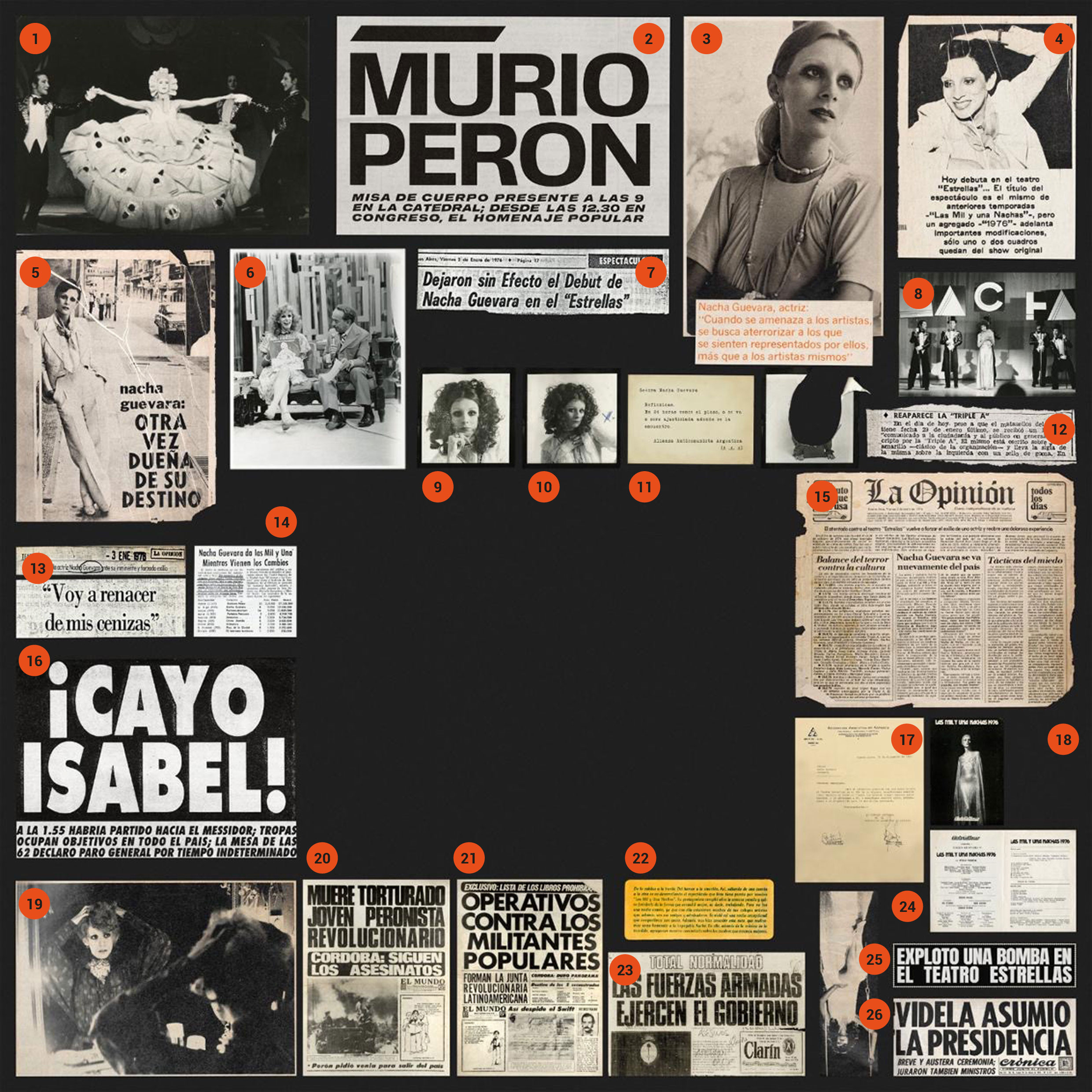
In January of that same year, at the Margarita Xirgu theatre — remodelled and adapted for the staging of café concert shows — Nacha Guevara had premiered Las mil y una Nachas [The Thousand and One Nachas]. It was a music hall-style production that was unusual for Buenos Aires, in which she played sixteen different characters against the backdrop of Claudio Segovia’s spectacular stage design. Despite its success, the show was forced to close in September owing to the threats against the singer made by the Alianza Anticomunista Argentina [Argentine Anticommunist Alliance], a paramilitary terrorist organisation also known as the Triple A. Nacha Guevara went into exile with her family, boarding a plane without saying any goodbyes and carrying little more with them than the clothes on their backs, 350 dollars, and fear. The plane made a stopover in Chile — at that time under the military dictatorship of Pinochet — where the family saw a headline that referred to them in the Chilean press: ‘Marxist rats flee’. Nacha, Alberto Favero and Norman Briski were the first Argentine artists to go into exile due to death threats.
Meanwhile, Isabel Perón’s government, under the influence of her Minister of Social Welfare and chief adviser José López Rega, intensified its repression.
In December 1975, Nacha returned to the country and reopened Las mil y una Nachas at the Estrellas theatre. The next day, 30 December, a bomb exploded in the theatre’s toilets: two people were killed and many were injured. The theatre season was cancelled. The Asociación Argentina de Actores [Argentine Actors’ Association] sent a letter. This time, the Triple A was adamant: Nacha Guevara must leave the country or she would be executed in the street. On 2 January 1972, she once again went into exile with her husband and three children. A prolonged exile was the only choice in the face of the death threats.
Nacha would not return to the country until 1984.
‘I take responsibility for each and every song I sing and every word I say, because I believe that what I say is the truth. Planting a bomb because of a word, a poem, or a song only proves that what we are doing is right’.