

2026
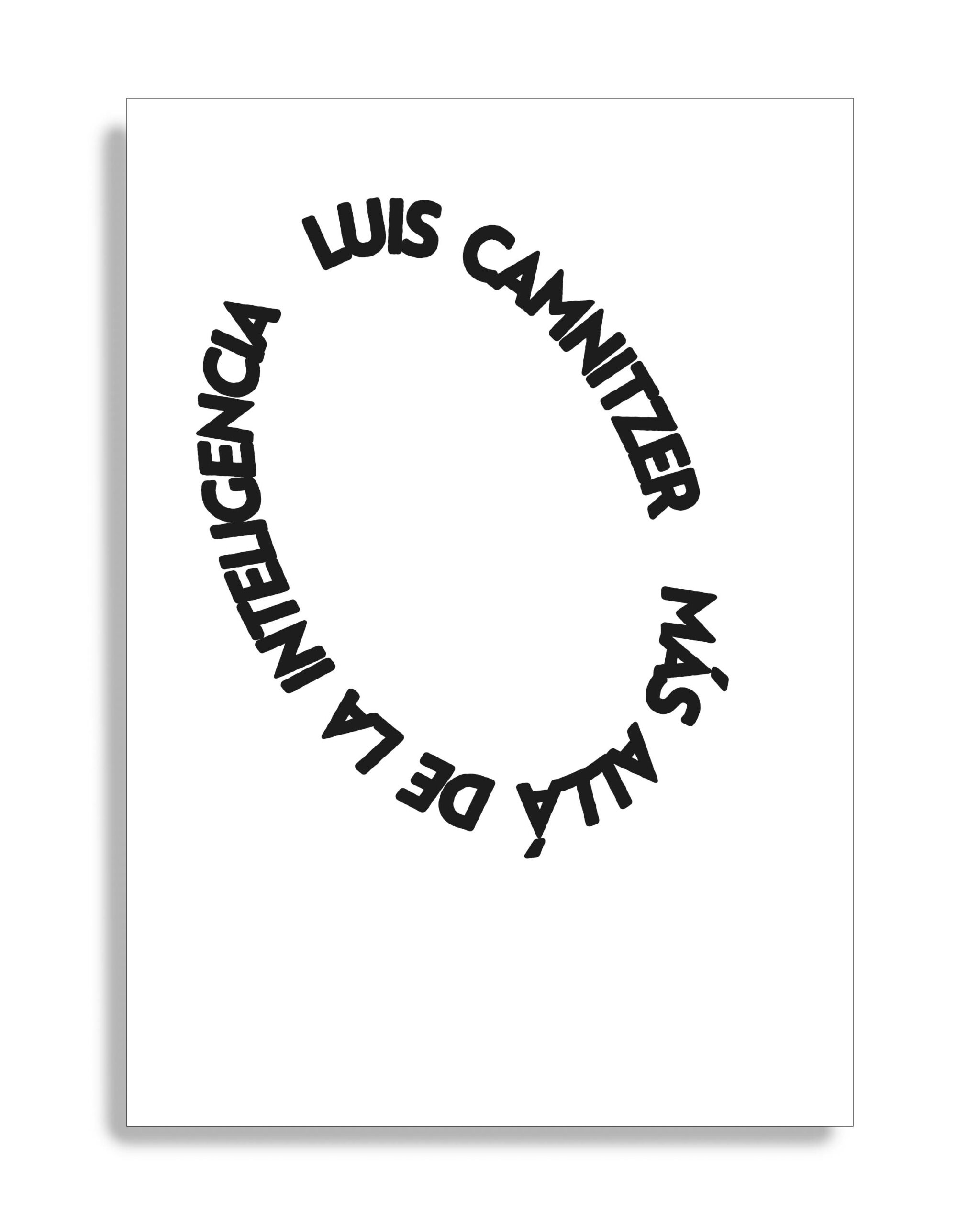
Spanish edition
Texts: Luis Camnitzer
Design: Job Salorio
–
344 pages
Format: 21 × 15 cm
ISBN 978-987-22339-4-5
–
In this book – a much-needed follow-up to In_utilidad: el arte como educación (Cruce Casa Editora, 2024), Luis Camnitzer reflects on AI’s scope today in the practices and creations of intellectuals and artists. In a series of essays and explorations, he puts a chatbot to the test. He acknowledges its positive impact in significantly facilitating and expanding access to data. But he also warns that many of AI’s decisions are beyond the user’s control. How can we strike a balance at this crossroads? In these pages, readers will find many and various paths to discovering their own answers.
Luis Camnitzer (Lübeck, Germany, 1937) is a Uruguayan artist who has lived in New York City since 1964. He is Professor Emeritus at the State University of New York at Old Westbury (SUNY at Old Westbury). He studied art at the Institute of Fine Arts of the University of the Republic (Udelar), Uruguay, and architecture at the Udelar’s Faculty of Architecture. A Guggenheim Fellow in both 1961 and 1982, he represented Uruguay at the 43rd Venice Biennale in 1988 and has exhibited works at various other biennials, including several editions of the Havana Biennial, the Whitney Biennial in 2000 and documenta 11 in 2002. A retrospective of his work was shown at the Reina Sofía Museum in 2018. His works are held in the collections of more than forty-five museums. He is represented by Alexander Gray Associates in New York. His publications include: Arte nuevo de Cuba [New Art of Cuba] (1994), Didáctica de la liberación. Arte conceptualista latinoamericano [Conceptualism in Latin American Art: Didactics of Liberation] (2008) and On Art, Artists, Latin America, and Other Utopias (2010), all published by University of Texas Press; De la Coca-Cola al arte boludo (2009), published by Metales Pesados; One Number is Worth One Word (2020) in the e-flux journal series, published by Sternberg Press; and In_utilidad: el arte como educación, published by Centro del Carmen Valencia and Cruce Casa Editora, Buenos Aires/Montevideo, 2024.
‘One of our deepest aspirations is to protect the museum in and of itself as a place of gathering and learning that encourages the discovery of reality in all its complexity and the discovery of ourselves in all our humanity. And it could not be otherwise once we understand art as education and education as art. It is in the understanding of this indissoluble unity that we find the work and pedagogical thought of Luis Camnitzer and other historical and contemporary artists for whom this debate is central. Of all Luis’s maxims, we have taken to heart the one that affirms his deep conviction in the power of art as a metadiscipline allowing us to expand the horizons of what we know and to gain access to sides of reality that have previously been unimaginable. For the same reason, his reflections – and provocations – are an open invitation not to overlook the power of imagination and fantasy, a constant reminder of the importance of devising projects, solutions and ways forward in the face of reality’s greatest challenges.’
Victoria Noorthoorn
‘As a citizen, my fundamental concern about AI is to do with the distribution of power: how much of the power I possessed or believed I possessed before the advent of AI is now controlled by it.’
‘Like many who have access to a computer, I too was immediately captivated by conversations with AI in the form of a chatbot. I am not sure whether chatbots pose a danger to me as the generic citizen I am. Nor am I sure whether they, along with AI-image-generators, are a threat to me as the artist I also am – though I fear they are. Threat or not, a major change is looming, and this unease makes me want to explore both sides of myself, as both citizen and artist. The inquiry I undertake in this book is personal and based on experiences which make no claim to be autobiographical but which I feel are necessary to illustrate certain points.’
Luis Camnitzer