Hermanas mías, hoy, con este voto, la vieja humillación va a terminar de las siervas del tiempo que en la mesa amasaron lágrimas y pan. Y por primera vez un voto cuenta lo que la Historia se negó a contar. En un papel, en unas pocas letras hay siglos de sufrir y de llorar
My sisters, today, with this vote, that old humiliation will come to an end of women servants at the table kneading the tears with the dough. And for the first time, a vote will count what history refused to account for. This piece of paper, with just its few letters, contains centuries of suffering and crying.
‘El voto femenino’ [‘Women’s Suffrage’], by Pedro Orgambide and Alberto Favero,
from the album Eva(el gran musical argentino) [Eva (The Great Argentine Musical)] (1986)
The story of Eva and Tita, Nacha Guevara’s great musicals, is also the story of the strength of women in the face of a society that tried to treat them as second-class citizens. From the humble margins of society, Eva Perón and Tita Merello challenged prejudices, broke down barriers and became national icons.
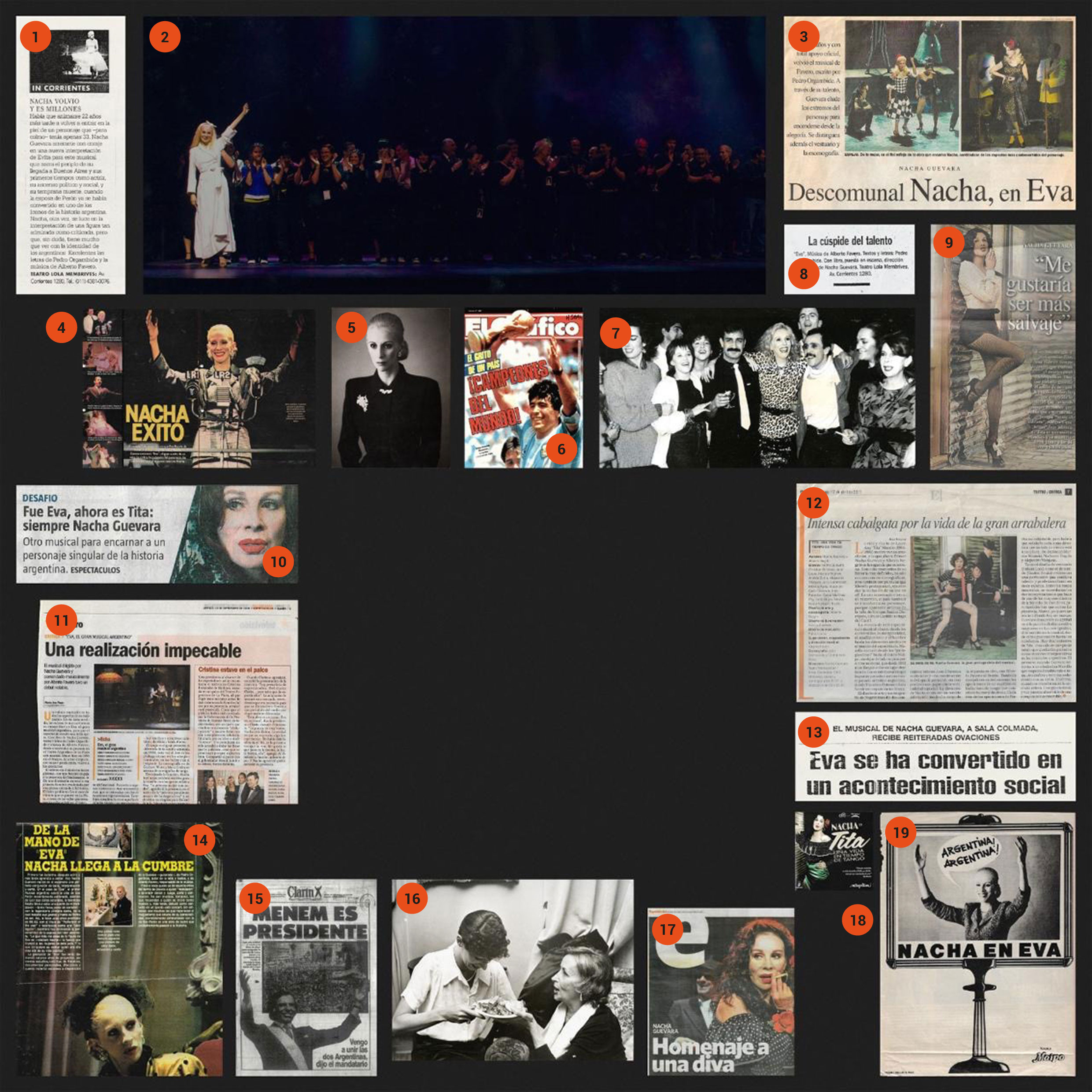
In 1986, at the Maipo theatre in Buenos Aires, Nacha premiered Eva: el gran musical argentino [Eva: The Great Argentine Musical], dedicated to the life of Eva Duarte de Perón and written by Nacha, writer Pedro Orgambide and musician Alberto Favero, during their exile in Mexico. Evita continued to be a divisive figure in Argentina. But this was a landmark show that put the spotlight on a woman who, both passionate and contradictory, transformed politics in Argentina and paved the way for future generations of women. When the musical was revived in 2008, audiences were much more willing to recognise the magnitude of her legacy.
In 2011, Nacha tread the boards once again in Tita, una vida en tiempo de tango [Tita: A Life in the Age of Tango], a show dedicated to the actress and singer Tita Merello. Tita began her career in the world of tango and authentic and uncompromising cinema, becoming an icon of freedom and courage in an age when the rights of women were limited and often denied.
These two productions consolidated Nacha Guevara’s reputation as a brilliant actress and director of musicals that put women at centre stage. With Eva and Tita, she not only told the stories of two exceptional women, she showed that the struggle for equality and the right to make one’s own choices have deep roots in Argentina’s history. They offer portraits of two women who overcame obstacles during their lifetimes, and at the same time make statements about the transformative power that women wield when they decide to change their destiny.
With these tributes, Nacha drew up a true manifesto on the critical and constructive power of women artists to address the challenges of the world, and of Argentina in particular.
‘Eva fulfilled her destiny. It is one of the things I most admire about her, because it isn’t easy to do. We all come into the world with a destiny, and it is our responsibility to discover what it is’.
‘Tita was as wild at the age of 14 as she was at 90. The extraordinary thing is that she never gave up, whether people liked it or not’.