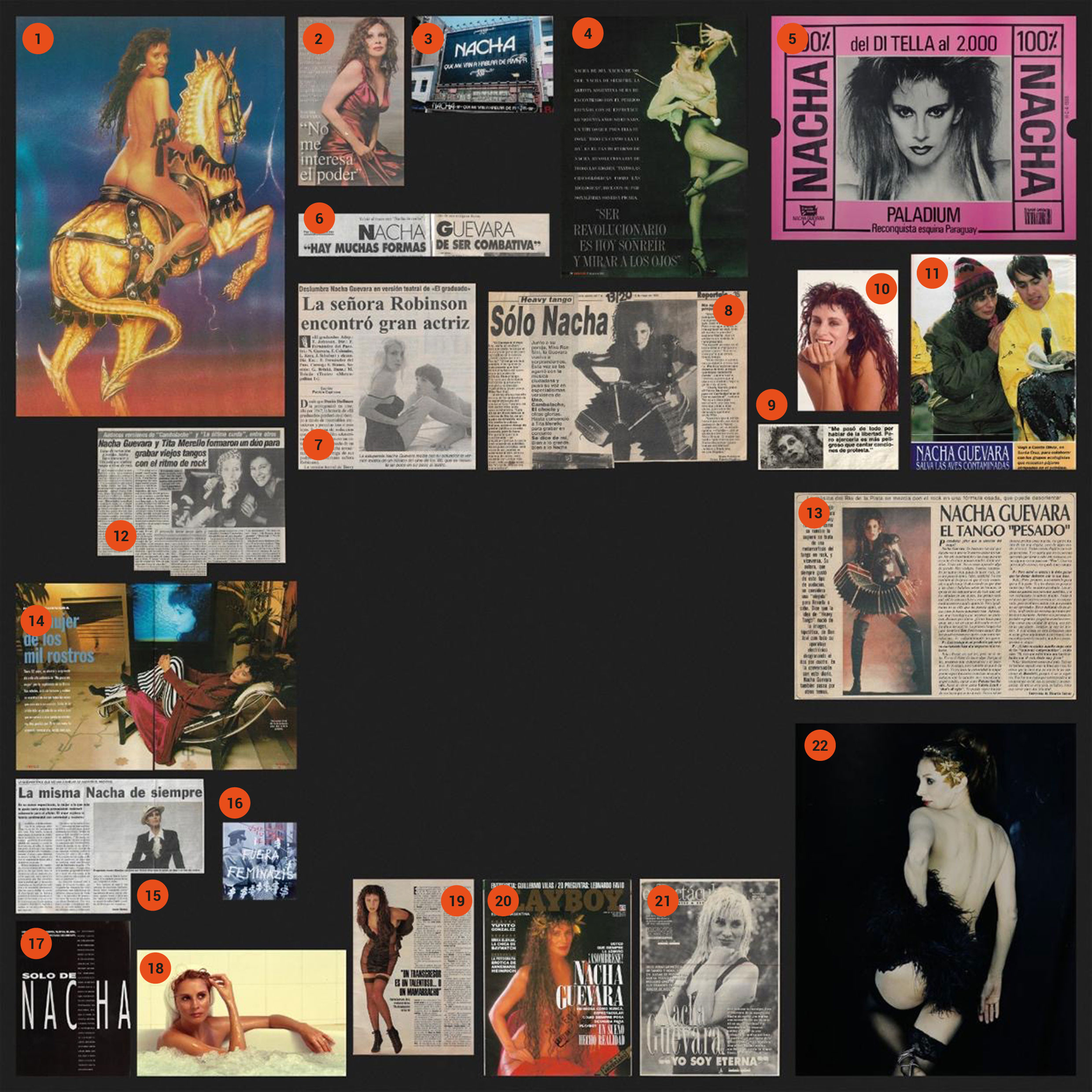
Nacha Guevara has never stopped evolving. Her ability to reinvent herself, both in her artistic and personal life, has made her a figure that defies categorisation. From the beginning, she has built a body of work defined by provocation and freedom and that has always been ahead of its time.
In the 1990s, when, after the fall of the Soviet block, the country aligned itself with the concept of globalisation and adopted hegemonic neoliberal policies, Nacha once again shook things up with Heavy Tango (1991), an album of tango classics with a hard rock twist. The artist took the risk of offering a personal and renewed perspective on the porteño genre, turning back to her rebellious roots. It was a challenge that, just as Astor Piazzolla had done with his compositions in the mid-20th century, would later extend to electronic tango.
She also surprised viewers with Me gusta ser mujer [I Like Being a Woman], a 1993 television series in which she spoke of topics ranging from yoga to meditation, healthy eating to caring for the planet: issues that had yet to be addressed by the media. The programme became the target of criticism and jokes, but it started a new conversation about feminism and healthy living that was yet again ahead of its time.
In 1999, her show Nacha canta a Discépolo [Nacha sings Discépolo], in which she was accompanied by an orchestra of young women, was a revolutionary gesture compared to the superficiality of the time, and oscillated between frivolity and disenchantment. In 2011, she played Tita Merello in Tita, una vida en tiempo de tango [Tita : A Life in the Age of Tango], breathing life into those popular, critical, somewhat marginalised and uncomfortable characters, and bringing back to the stage a message of resistance in an age of commercial rhetoric and conformity. Just when she seems to have settled in one place, Nacha makes a move to shake things up again, to challenge a society anxious to pigeonhole her.
Today, with a career that has spanned more than five decades, Nacha continues to sing whatever she likes and is an enduring icon of disobedience. With an ability to reinvent herself and break the mould, she seems younger by the day.