

As part of the 2025 Exhibition Programme, Arte es teatro [Art Is Theatre], the Museo de Arte Moderno de Buenos Aires presents the international symposium Teatrismo [Theatrism], which sets out to examine the links between contemporary art, theatre and society in light of the current crisis in democracies, the digital duplication of life and the disruption of human relations caused by the global experience of the pandemic.
Renowned Argentinian and international artists, thinkers and specialists will share their knowledge and ideas over three days of lectures, public talks, performances and film screenings.
Participation & works by: Ana Alvarado, Norman Briski, Alejandro Cruz, Carlos Furman, Víctor García, Emilio García Wehbi, Ricardo Ibarlucía, Tadeusz Kantor, Susanne Kennedy, Brai Kobla, Federico León, Ana Laura Lozza, Barbara Hang, Jarosław Lubiak, Małgorzata Ludwisiak, Juan Carlos Malcún, Victoria Noorthoorn, Mariana Obersztern, Małgorzata Paluch-Cybulska, Alejandro Tantanian.
Civic Theatre
In a global context where the very possibility of living together as a social body is in crisis, how is the power of theatre as an inherently collective art form involving the body revitalised? Can theatrical fiction take on the role of a public agora? In what ways can the theatrical experience counteract the rise of hate speech and the erosion of democratic institutions? What responsibilities and opportunities confront cultural institutions such as museums and theatres in this social and political climate? Can the performing arts offer a new grammar for the social imagination? How can a politics of presence reformulate the way we understand the living and the collective in a post-pandemic context? Are new ritual forms emerging in the theatrical sphere?
Welcome speech
1.30 p.m.
Victoria Noorthoorn, Director, Museo de Arte Moderno de Buenos Aires.
Introduction to the Symposium
1. Round table – The Tradition of Radicalism
1.45 p.m. to 2.45 p.m.
Alejandro Tantanian, Federico León and Brai Kobla review the legacy of anti-naturalistic theatrical experimentation in the 1960s and 1980s and reflect on the meaning and urgency of such theatrical radicalism today. What forms of experimentation resonate most with the current crisis of representation? Moderated by Alejandro Tantanian.
2. Interview – Norman Briski
3:00 p.m. to 3:40 p.m.
Renowned actor, director and acting teacher Norman Briski stands as a living witness to the scene that emerged out of the Di Tella Institute’s Audiovisual Experimentation Centre (CEA), featured in the exhibition Esto Es Teatro. His aesthetic commitment is inseparable from the social activism he pursues from his theatrical platform: the independent Caliban Theatre. Interview to be conducted by Fernando García.
Break: 3:45 p.m. to 4:00 p.m.
3. Interview – Archives of Radicalism: Víctor García
4:00 p.m. to 5:00 p.m.
In an interview to be conducted by Alejandro Cruz, set designer and architect Juan Carlos Malcún guides us on an exploration of Víctor García’s visionary theatrical language. He also reflects on the role of archives in documenting theatre, an artform defined by its very ephemerality. How can symbolic and material archives keep a record of experiences that are at once intense and fleeting? How can archives be re-imagined and exhibited for today’s audiences?
4. Screening – Susanne Kennedy’s Angela
5:10 p.m. to 7:30 p.m.
A screening of Susanne Kennedy’s piece, presented by Alejandro Tantanian, and a short video by the artist. Susanne Kennedy is a German contemporary theatre director and playwright whose works inhabit a powerful and disturbing theatrical universe. Through the use of masks, pre-recorded voices and other means of altering perception, it challenges the conventions of realism and the presence of actors on stage.
This activity is supported by the Goethe-Institut Buenos Aires.
The Dramatic Machine: Trauma and the Body of Theatre
Can theatre heal the wounds of history? What does a term like ‘performance’ mean in a context where the limits of humanity are blurred by such technological advances as artificial intelligence and bio-engineering? Does the stage still belong to the human? How can theatrical practice respond to the crisis of meaning accelerated by contemporary phenomena? Is the ‘actor’ still a central figure, or has a new figure of the more-than-human ‘performer’ emerged? What light does Tadeusz Kantor’s experience of theatrical radicalism shed on the contemporary condition? How can we redefine contemporary art and its possible reparative function if we view it through a Kantorian lens?
1. Round table – Rewriting the Myth of Tadeusz Kantor
1.30 p.m. to 3 p.m.
Three leading Polish researchers and curators explore Tadeusz Kantor’s theatre as a space besieged by historical trauma and preoccupied with the continuity between man and machine, as well as its potential to interpret the field of contemporary art. Małgorzata Paluch-Cybulska, head of the Tadeusz Kantor Museum at the Centre for the Documentation of the Art of Tadeusz Kantor Cricoteka in Kraków, will introduce the main characteristics of Kantor’s theatrical and artistic practice. Jarosław Lubiak, Deputy Director of the National Museum in Szczecin, and Malgorzata Ludwisiak, former artistic director of the Museum of Modern Art in Warsaw and independent curator, will present two perspectives on how Tadeusz Kantor’s theatre may be reconsidered from a contemporary art standpoint and vice versa. Moderated by Małgorzata Ludwisiak.
Tadeusz Kantor’s theatrical work had a remarkable impact on the development of experimental theatre and the visual arts in Argentina during the 1980s and 1990s. In 1984 the play Wielopole, Wielopole, and in 1987 Let the Artists Die were performed at the San Martín General Municipal Theatre, in Buenos Aires, and led directly, among other things, to the creation of the group El Periférico de Objetos [The Peripheral of Objects], a retrospective of which will be open during the conference. The ‘post-Kantor’ echoes in Argentina, on the one hand, and the absence of conscious Kantorian references in Polish art and theatre, on the other, led the symposium’s curatorial team to ask questions about the possible updating of Tadeusz Kantor’s radical propositions fifty years on from the premiere of the play The Dead Class, which, according to critics, revolutionised world theatre. What would happen if we turned Kantor’s theatrical legacy into a set of methodological tools and applied them to the field of contemporary art? Or conversely, what would happen if a strictly formal visual analysis were applied to Kantor’s plays?
As one of this panel, Małgorzata Paluch-Cybulska will present the figure of the artist and the key concepts he tested on stage. Following her introduction, two art critics will apply a visual arts approach to Kantor’s theatre and vice versa. Jarosław Lubiak will focus on analysing Kantor’s plays as time-based media works pursuing the internal relationships between the elements and rhythms of their movements. How does the very composition of the performances structure their meaning? Małgorzata Ludwisiak will look at such theatrical concepts of Kantor’s as materiality, the body, memory and the bio-object or theatrical object, from the perspective of post-human art and as a means of interpreting contemporary artistic practices. What might ‘theatrism’ mean in the visual arts? Can it help us better understand our contemporary condition?
2. Interview – Mariana Obersztern
3:10 p.m. to 4:00 p.m.
In this public interview with Fernando García, Mariana Obersztern will reflect on her experience with Wielopole, Mezrich, Wielopole, a 2017 piece in which she explored the work of Tadeusz Kantor.
Break: 4:00 p.m. to 4:15 p.m.
3. Interview – El Periférico de Objetos
4:30 p.m. to 5:30 p.m.
Theatre critic Alejandro Cruz will talk to Ana Alvarado and Emilio García Wehbi, members of the experimental collective El Periférico de Objetos, about the mark left by Kantor’s theatre on their materialist dramaturgy.
4. Kantor Film Night #1 –Haunting? All Returns by Tadeusz Kantor
6:00 p.m. to 7:45 p.m.
Selection curated by Jarosław Lubiak
I Shall Never Return, declares Kantor in the title of one of his last plays. Let us take this as a rhetorical figure, the opposite of what he means. With humour and even sarcasm, he threatens and promises: I shall never leave you, or I shall always haunt you, like a ghost. Kantor knew perfectly well how memory and history work, with their endless repetition of loss and suffering, hope and renewal. His theatrical work explored the modes and effects of that repetition. What is lost returns as a spectre, making encounters–and even life together–possible.
From our perspective, Kantor’s endless mourning can be read today as an experience similar to our struggle against the loss of the world to environmental catastrophe and its accompanying crises. ‘Climate mourning’ may have no end and no solution, for loss, in this case, is a continuous process. We must, therefore, learn to work with grief once more. Perhaps Kantor’s theatre and his strategy of spectral repetition may serve as a guide.
This screening returns Tadeusz Kantor to us in four episodes. The first film showcases his visual art, which provides context for his stage work. The second presents one of his earliest and most important plays. The third offers a summary and original re-interpretation of his early theatrical work. The fourth focuses on cricotage, Kantor’s experiment in theatrical form. These films can take us back to a time when there was a belief that repeating the past could free us from it.
Farbą [With Paint]
Directed by Artur Janicki, screenplay by Zofia Gołubiew, 1992, colour, 33 mins.
Documentary on the exhibition Tadeusz Kantor: Painting and Sculpture. National Museum in Kraków, 1991, produced by Polish Television (TVP).
The film tells the story of the artist’s work based on the exhibition Tadeusz Kantor: Painting and Sculpture, presented as a tribute at the National Museum in Kraków in 1991, shortly after his death. The film also includes excerpts from Kantor’s statements, combined with his work. It is both an introduction to his oeuvre and a supplement to the documentation of his theatrical performances.
Umarła Klasa. Seans T. Kantora [The Dead Class: The T. Kantor Show]
Directed by Andrzej Wajda, 1976, colour, 72 mins.
Produced by Polish Television (TVP).
Andrzej Wajda’s film is an interpretation of Kantor’s play The Dead Class. It is one of his most important plays, allowing the audience to immerse themselves in his mourning for the lost world of childhood and youth, the last act of destruction of which was the Second World War. The mechanism of the return of the past as obsessive-compulsive repetition reveals itself here with greater force. At first glance, the pathos and lamentation for the irreversibility of loss appear to consume the artist and the audience. But humour and the grotesque allow the artist to break the vicious circle of dead repetition. Perhaps they, too, can help us as we live out our own catastrophe.
Theatre, Liturgy and Transcendence
How does the ritual dimension of theatre connect with the forms of liturgy? In an age dominated by disorientation and hyper-individualism, can theatre re-awaken a sense of ‘sacred time’ and collective transformation? What kind of dramaturgy arises from spiritual longing and how can it resist the crushing effects of spectacle, commodification and the false certainties of today’s materialistic culture? Can contemporary experimental theatre, with its acceptance of mystery and ambiguity, provide a space in which deeper truths can emerge that elude the noise of conventional media and the crisis of meaning in our public discourse?
1. Lecture – Ricardo Ibarlucía
1.30 p.m. to 2.30 p.m.
Why do we need theatre today? Based on this question, one of the sharpest minds in Argentina’s academic community outlines a historical-philosophical perspective on the contemporary possibilities of theatre.
2. Lecture – Carlos Furman
2:30 p.m. to 3:30 p.m.
From the San Martín Theatre to the Cricoteka, Photographer Carlos Furman, who has documented the whole of Tadeusz Kantor’s work in Buenos Aires, reveals the story behind his exhibition in Kraków and his ties to his Polish family.
Break: 3:30 p.m. to 3:45 p.m.
3. Performance – Consumation [Consummation]
4:00 p.m. to 5:00 p.m.
Dancers and performers Ana Laura Lozza and Bárbara Hang close the Symposium with the performance Consummation #1 (2018), invoking the ritual dimension of the theatrical act.
4. Kantor Film Night #2 – Haunting? All Returns by Tadeusz Kantor
5:30 p.m. to 7:30 p.m.
Selection curated by Jarosław Lubiak.
Nigdy już tu nie powrócę [I Shall Never Return Here]
Directed by Andrzej Sapija, 1990, 80 mins.
Produced by Polish Television (TVP).
Kantor worked with his team on the play I Shall Never Return in 1987 and 1988. The premiere took place at the Piccolo Teatro Studio in Milan. The film is a recording of a revised version of the play, presented in Warsaw in 1990. In I Shall Never Return, the artist analyses and re-interprets his own work. It is an original summary composed of self-quotations. Kantor refers to the plays Powrót Odysa [The Return of Odysseus], 1944; Kurka Wodna [The Water Hen], 1967; Nadobnisie i koczkodany [Dainty Shapes and Hairy Apes, or the Green Pill], 1973; Umarła klasa [The Dead Class], 1975; Gdzie są niegdysiejsze śniegi [Where Are the Snows of Yesteryear?], 1979; Wielopole, Wielopole, 1980, and Niech sczezną artyści [Let the Artists Perish], 1985. This was the last work the artist completed and performed.
Gdzie są niegdysiejsze śniegi [Where Are the Snows of Yesteryear?]
Directed by Andrzej Sapija, 1984, 32 mins.
Produced by Wytwórnia Filmów Oświatowych, Łódź.
Kantor first used the term cricotage (from the name of his theatre, Cricot 2) to describe his first happening in 1965. Later, based on the play Where Are the Snows of Yesteryear? (1979), he applied it to short theatrical forms, performed outside large-scale productions, or to stage experiments with students. In this cricotage, the artist continues his reflection on whether it is possible to recover the lost past, a theme further developed in the work Wielopole, Wielopole (1980).
Produced by Museo de Arte Moderno de Buenos Aires and co-financed by the Ministry of Culture and National Heritage of the Republic of Poland
With special thanks to: The Embassy of the Republic of Poland in Argentina
The Centre for the Documentation of the Art of Tadeusz Kantor Cricoteka, Kraków, Poland
The Goethe-Institut Buenos Aires
More information about the Adam Mickiewicz Institute & Culture.pl
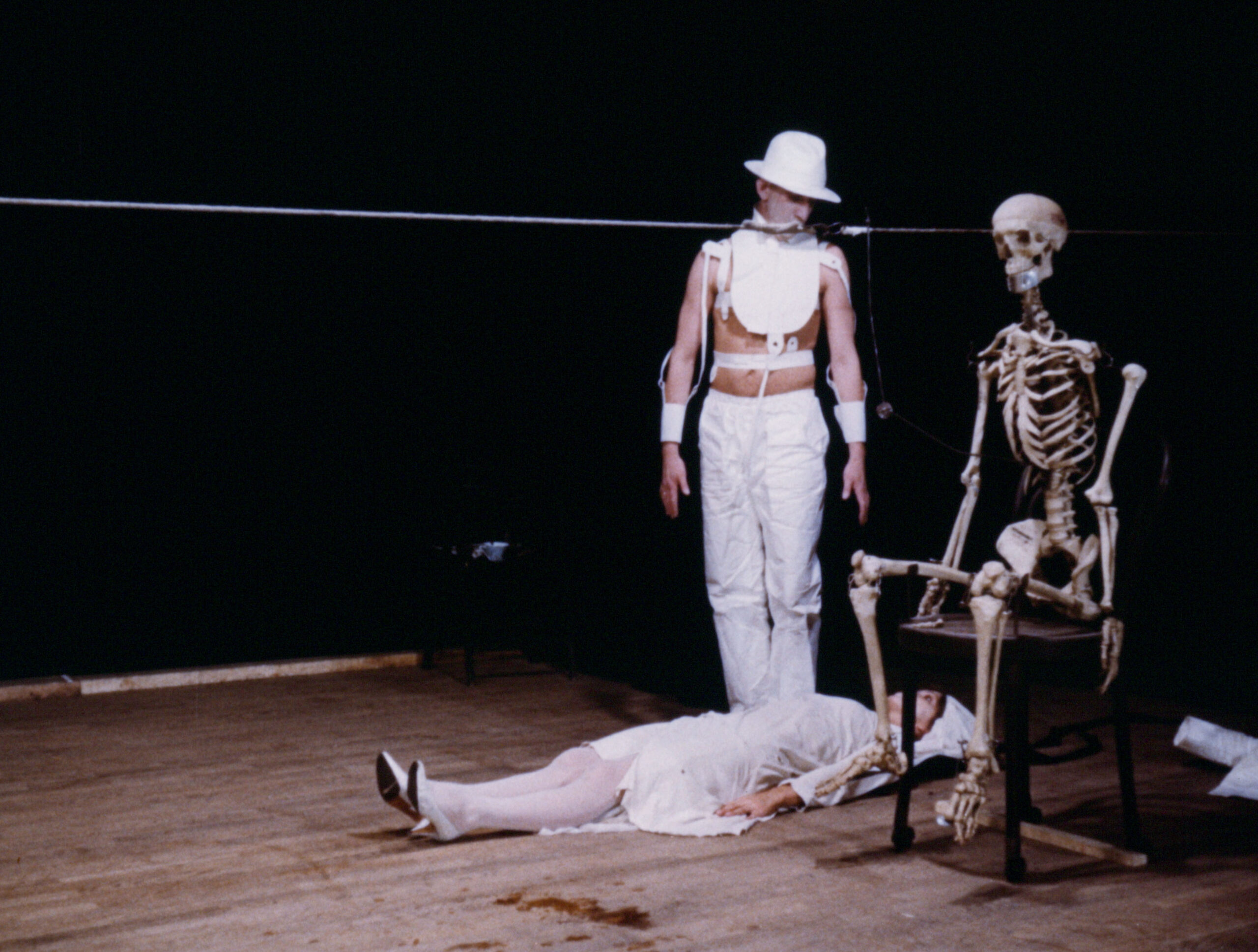
Still from the film
Gdzie są niegdysiejsze śniegi [Where Are the Snows of Yesteryear?]
Directed by Andrzej Sapija, 1984, 32 min.
Produced by WFO, Łódź.
Ana Alvarado
(Buenos Aires, Argentina)
A director and playwright, Alvarado produces works for both children and adults that generally emerge from her research into expanded theatre and into theatre that involves actors, objects and puppets in combination with the visual and multimedia arts. She has participated in festivals and events in America, Oceania and Europe, including BAM (New York), the Kunsten Festival (Brussels), El Cervantino (Mexico), Porto Alegre em Cena (Brazil), Theatre der Welt (Berlin), the Avignon Festival, the Melbourne Festival, the Bogotá Festival, the Guadalajara International Puppet Festival and the Mar del Plata Ibero-American Theatre Festival. She is also a member and co-director of the El Periférico de Objetos theatre group and the Puppetry Group of the Teatro San Martín.
She has been the recipient of several prizes and honours, including the Fondo Nacional de las Artes Prize, the Argentores Prize, the City of Buenos Aires Prize, the Platinum Konex Award, the Teatro del Mundo Award, the ACE Award, the María Guerrero Award, First Prize at the Edinburgh Festival, the Ibero-American Theatre Festival Summit of the Americas Award, and the Siripo Award (Córdoba). She also teaches at different national universities. Alvarado is the director of the Theatre of Objects, Interactivity and New Media Postgraduate Specialisation course at the Universidad Nacional de las Artes and was a member of the teaching staff for the Bachelor in Theatrical Arts programme at the Universidad Nacional de San Martín, Argentina. Her works for children have been published by Jacarandá Editoras, Aique, Atuel, Estrada, CELCIT, Centro Cultural de la Cooperación and Biblioteca Nacional, among others.
Norman Briski
(Santa Fe, Argentina)
As an actor, playwright and director in both film and television, Briski has been a legend on the Argentinian arts scene since his breakthrough in 1966 at the Instituto Di Tella with his play El niño envuelto [The Swaddled Child]. In 1969, Briski attained mainstream recognition and won over critics with his iconic performance in La fiaca [Layabout], the film version of Ricardo Talesnik’s play, directed by Fernando Ayala. His acting credits include more than 70 films, such as Psexoanálisis [Sexanalysis], La Guita [The Dough], Mamá cumple cien años [Mum Turns 100], Elisa, vida mía [Elisa, My Life] (directed by Carlos Saura), La cruz [The Cross] (Official Selection at Cannes) and Argentina, 1985. Several generations of diverse audiences recognise him from his television work, with such hits as Tiempo final [Final Countdown], Mujeres asesinas [Killer Women], Botines [The Loot], Vulnerables [Vulnerable] and ¡Socorro! Quinto año [Help! Year 5]. As a theatre director, he has left an indelible impression on the stage with Gurka (Vicente Zito Lema), Señor Galíndez [Mr Galíndez] (Eduardo Pavlosvski), as well as with plays of his own authorship, such as Rebatibles [Refutable] and Con la cabeza bajo el agua [Underwater]. Briski has written about his method and experience in books such as Teatro del actor [The Actor’s Theatre], Teatrobrik: cinco obras de teatro y un guion televisivo [Teatrobrik: Five Plays and a Television Script], Norman Briski: Mi política vida [Norman Briski: My Political Life] and Teatro necesario [Necessary Theatre]. He has demonstrated an unwavering social commitment throughout the course of his extensive career, using the stage as a platform for political transformation. His commitment has been particularly evident in the creation of popular theatres such as Octubre, Argenta (New York), Teatro Popular and Brazo Lago, as well as his independent theatre, Calibán, where he continues to premiere his own productions as well as providing a platform for new creators.
Alejandro Cruz
(Buenos Aires, Argentina)
A social communication analyst and graduate of the Universidad del Salvador. For more than thirty years, Alejandro Cruz’s journalistic work has focused on the performing arts and other cultural management issues. He has worked for magazines such as La Maga, Rolling Stone, El Picadero, La Nación Revista, and others. He was the co-host and creator of the programme Nuevas Tendencias [New Trends] on Canal á, the same station where he also presented a weekly show about theatre. Cruz was also a member of the programme Todo teatro [All Theatre], which aired on both Televisión Pública and Canal á and was supported by the Instituto Nacional del Teatro (INT). He has curated several editions of the Festival de Nuevas Tendencias/La Movida [New Trends/The Movement Festival], organised by the Centro Latinoamericano de Creación e Investigación Teatral, and of the programme Proyecto Cruce [Crossing Project], which took place during two editions of the Buenos Aires International Festival. Cruz has been a member of the jury at the National Theatre Festival, the INT, and the Mercado de Industrias Culturales Argentinas [Argentine Cultural Industries Market]. He is co-author, with Gabriela Ricardes, of the book Circo expandido [Expanded Circus], published by the Buenos Aires Ministry of Culture and the French Embassy. He is co-editor, with Carlos Pacheco, of the book Ponete el antifaz [Put On the Mask], based on the archive of Alberto Ure and published by INT. In 2011, he won First Prize from the Argentine Association of Journalistic Entities (ADEPA) in the category of General Information and Entertainment. Since 1997, he has worked for the ‘Entertainment’ and ‘Culture’ sections of the La Nación newspaper.
Carlos Furman
(Buenos Aires, Argentina)
A photographer with more than thirty years of experience at the Teatro General San Martín, Furman is known for his unique approach to photographing the performing arts. He has participated in numerous individual and group shows in Argentina (Museo Nacional de Bellas Artes, Centro Cultural Recoleta, Museo Moderno, Fotogalería del Teatro San Martín, Centro Cultural Ricardo Rojas, among others) and held exhibitions in Cuba, Uruguay, Chile, Italy, Poland, Brazil, Spain and Colombia. Major exhibitions include Feliz viaje [Happy Travels], Tesoros [Treasures] and Tango. His works are held in national museums and in private collections. In 2006, his photography show Que revienten los artistas [Let the Artists Explode] was held at the Cricoteka in Krakow, Poland: an exhibition in which he traced the presence of the great Polish theatre director Tadeusz Kantor at the Teatro General San Martín over the years. In 2007, he published Tango, for which he was awarded second prize for the Best Book printed and published in Argentina. He is winner of the Banco Nación Visual Arts First Prize (2016), the María Guerrero Photography Prize (2023) and the Teatro del Mundo Prize (2023). Also in 2023, Furman held the exhibition Sobre lugares lejanos y un sueño escondido [On Distant Places and a Hidden Dream], curated by Florencia Qualina, at the Gachi Prieto Contemporary Latin American Art Gallery, for which he received favourable reviews in the national press. He is currently preparing a new photography exhibition for the end of the year.
Emilio García Wehbi
(Buenos Aires, Argentina)
A self-taught, interdisciplinary artist who works with a combination of different artistic languages, Garcia Wehbi is renowned for his activities as a theatre director, stage manager, performer writer, visual artist and teacher. His poetics defy the established aesthetic categories, by blending the disciplines in such a way that his creations refuse to be bound by precise definitions. In formal terms, his approach always seeks to establish a dialogue with the viewer or reader, as he considers them an active part of the work. His shows, operas, performances, installations and urban interventions have been seen in America, Europe, Oceania and Asia. He has won national and international awards.
As a director, his works include: ¡Escucha, ángel medio muerto, soy semejante a ti! [Listen, half-dead angel, I’m like you!] (2025), Fritzl agonista [Fritzl Agonist] (2025), La nuda vida [Naked Life] (2024), Operativo Libertad Total [Operation Total Freedom] (2024), Orlando. Una ucronía disfórica [Orlando: A Dysphoric Alternate History] (2017), Trilogía de la Columna Durruti [The Durruti Column Trilogy] (2017), En la caverna de Platón / la cabeza de la Medusa [In Plato’s Cave/The Head of the Medusa] (2017), 65 sueños de Kafka según Guattari [65 of Kafka’s Dreams According to Guattari] (2016) and El grado cero del insomnio [A Zero Score for Insomnia] (2015). As a member of El Periférico de Objetos, Garcia Wehbi participated in works such as La última noche de la humanidad [The Last Night of Mankind] (2002), Monteverdi método bélico [Monteverdi Warfare Method] (2000), Zooedipous (1998), Máquina Hamlet [Hamletmachine] (1995), Cámara Gesell [Gesell Dome] (1994) and El hombre de arena [The Sandman] (1992).
His published books include Dafne sobre fondo de monte Fují [Daphne Against the Backdrop of Mount Fuji], El periférico de objetos. Un testimonio [El periférico de objetos: A Memoir], Trilogía de la Columna Durruti [The Durruti Column Trilogy], Artaud: lengua madre [Artaud: Mother Tongue], and others.
Ricardo Ibarlucía
(Buenos Aires, Argentina)
A philosopher and intellectual historian specialising in aesthetics, Ibarlucía is a senior researcher at the National Scientific and Technical Research Council (CONICET), professor at the Universidad Nacional de San Martín and member of the Centre for Philosophical Research (CIF). He was a member of the Board of Directors of Diario de Poesía (1986-2012). He has translated works by Paul Celan, Louis Aragon, Allen Ginsberg and Werner Herzog, among others. Ibarlucía ventured into playwriting with a translation of an unabridged version of Goethe’s Walpurgis Night (1999). Together with Alejandro Tantanian, he adapted Bertolt Brecht’s The Threepenny Opera (2004), the source for the version directed by Betty Gambartes. In 2006, he presented Woyzeck por Woyzeck [Woyzeck by Woyzeck], inspired by Georg Büchner’s play and directed by Emilio García Wehbi, with whom he also collaborated on El Matadero.5: Aullido [Slaughterhouse.5: Howl] (2008) and an adaptation of Sophie Calle’s Exquisite Pain (2008-2009). In 2004, he presented Velada Fantomas. Opereta radiofónica [Fantomas Evening: A Radio Operetta], based on a radio play by Robert Desnos and staged by Walter Jakob and Agustín Mendilaharzu. His most recent books include Belleza sin aura. Surrealismo y teoría del arte en Walter Benjamin [Beauty Without Aura. Surrealism and Art Theory in Walter Benjamin] (2020), and ¿Para qué necesitamos las obras maestras? Escritos sobre arte y filosofía [Why Do We Need Masterpieces? Writings on Art and Philosophy] (2022).
Susanne Kennedy
(Friedrichshafen, Germany)
A director and playwright, Kennedy is one of the most unique voices in European theatre. Her pieces are a radical invitation that include the real as part of the performance, for which she explores possible interactions between the actor and the machine. The performers in her theatrical works wear masks and speak using pre-recorded voices, allowing Kennedy to question the notion of a stable reality through changes in perception and the continual confusion brought about through hypnotic images. Her work challenges the limits of theatre and draws on the medium’s roots in archaic rituals to raise profound, even confrontational questions, such as: Who are we? Why do we exist in this world? How do we relate to our own demons?
Kennedy studied theatre in Germany and France. She completed the director’s course in Amsterdam in 2005. Together with visual artist Markus Selg, she designs spaces that resemble the virtual corridors encountered in video games and colourful psychedelic hallucinations. Her adaptation of Anton Chekhov’s Three Sisters represents a milestone in contemporary European theatre. Angela (a strange loop) is Kennedy’s first production to be seen in Argentina.
Brai Kobla
(La Plata, Argentina)
A playwright and director, Kobla studied playwriting with some of the great names of London’s Royal Court Theare, such as Ella Hickson, Simon Longman, Simon Stephens and Matías Feldman. Kobla has participated in different international residencies and masterclasses on documentary theatre and multidisciplinary creation with Stephan Kaegi, Mohamed El Khatib and Rimini Protokoll, among others. His gGrants and scholarships include: Creador.ES (Valencia); Director’s Lab/Lincoln Centre (New York): Williams Foundation; the New Opera Scholarship from the Teatro Mayor (Bogotá); Casa de América (Madrid), Fondo Nacional de las Artes (Buenos Aires); and was selected by the Buenos Aires Young Art Biennial as a resident artist for the International Playwriting Workshop at Sala Beckett (Barcelona). Kobla’s works have been staged in Argentina, Spain, Colombia, Portugal, Cuba, Brazil, Panama, Mexico and Chile. Their play Oveja [Sheep] was awarded Best Playwriting at the Buenos Aires Young Art Biennial and received the Godot Award (Madrid) for Best Play of the 2024 season. Kobla directed and adapted Jean Cocteau’s opera The Human Voice, which premiered during the 2021 season at the Teatro Mayor in Bogotá and was a co-production of the Bogotá Philharmonic Orchestra and the British Council. Kobla also created and teaches at Motín experimental [Experimental Mutiny], a multidisciplinary creative space housed within the Dissident Identities Ward of the Lisando Olmos Penitentiary No. 1, and is a member of Nélida Underground, an artists’ collective in the city of La Plata.
Federico León
(Buenos Aires, Argentina)
A playwright, director and actor, León has written and directed the plays Cachetazo de campo [A Country Slap] (1997), Museo Miguel Ángel Boezzio [The Miguel Ángel Boezzio Museum] (1998), Mil quinientos metros sobre el nivel de Jack [Fifteen Hundred Metres Above Jack’s Level] (1999), El adolescente [The Adolescent] (2003), Yo en el futuro [My Future Self] (2009), Las multitudes [Crowds] (2012), Las ideas [Ideas] (2015), Yo escribo. Vos dibujás [I write. You draw.] (2019), Los tiempos [The Times] (2023) and El trabajo [Work] (2025). In 2002, he wrote, directed and starred in his first film, Todo juntos [All Together], followed in 2007 by his second film, Estrellas [Stars], which he wrote and directed together with Marcos Martínez. In 2009, together with Martín Rejtman, he wrote and directed the television film Entrenamiento elemental para actores [Basic Training for Actors]. In 2014 and 2019, he made La última película [The Last Film], which consisted of a series of interventions in former cinemas that had been converted into car parks.
León has received several honours and awards for his work, including: the First Prize for Playwriting from the National Theatre Institute (INT), the 2004 Konex Award in Literature for productions from the five-year period 1999–2003, the Fondo Nacional de las Artes Award and the First National Prize for Playwriting 1996–1999. His plays and films have been shown in theatres and at festivals in Germany, France, the Netherlands, Austria, Italy, Denmark, Scotland, Canada, Belgium, Spain, Brazil, the United States, Australia, Switzerland, Greece, Portugal, Lebanon and Japan. As a teacher, León has offered workshops in Argentina, Spain, France, Belgium, Costa Rica, Bolivia, Greece, Chile and Lebanon. Some of his plays, the script for Todos juntos, as well as reviews, interviews and texts by the author discussing his creative process, have been published in the book Registros-Teatro reunido y otros textos [Records: Collected Theatre and Other Texts].
Ana Laura Lozza & Bárbara Hang
(Buenos Aires, Argentina)
This duo of artists works in contemporary dance and experimental choreography as well as performance, education, writing and interdisciplinary work. They have researched the poetics and ethics of collective action over the course of their more than 15 years of collaboration. Their practice delves into the material and immaterial dimensions of the body in encounters with others, using movement, language, musical scores and everyday actions as a means to create artworks. Their current research on radical relational states began in 2023, with the duo Commitment and the workshop Las manos en la boca [Hands in the Mouth]. Behind each of their projects lies the recurring question of ‘How to do things together?’, a question that opens itself to other bodies and to more than the human world, connecting with the fragile, uncertain and unexpected nature of relating to one another.
Jarosław Lubiak
(Poland)
An academic professor, art theorist and independent curator, Lubiak is the assistant director of the National Museum in Szczecin, Poland. Between 2014 and 2019, he was artistic director of the Ujazdowski Castle Centre for Contemporary Art in Warsaw. He worked at the Museum of Art in Lodz as a curator and head of the Department of Modern Art between 1996 and 2014.
He recently curated Angelika Markul: Time Formula at Openheim, Wrocław, Poland (2021); The Plasticity of the Planet, a long-term programme addressing the climate catastrophe through various activities, including parallel exhibitions such as Human-Free Earth and Forensic Architecture: Centre for Contemporary Nature, at Ujazdowski, and the publication Becoming Earth and Plasticity of the Planet: On Environmental Challenge for Art and Its Institutions (2019). Among many other projects, he also curated The State of Life: Polish Contemporary Art within the Global Context, at the National Art Museum of China, Beijing (2015), and co-curated, with Małgorzata Ludwisiak, Correspondences: Modern art and Universalism, at the Museum of Art in Lodz (2012). His work as a curator and art theorist focuses on the intersections between contemporary art, philosophy and society, as well as the clashes between aesthetics and politics and the frictions between art institutions, political economy and environmental crises.
Małgorzata Ludwisiak
(Lodz, Poland)
An art historian, critic, curator, expert in museum management and university lecturer, Ludwisiak graduated with a degree in Art History from the University of Lodz, where she obtained her PhD in 2006. She was director of the Lodz Biennial in 2006 and, in 2007, launched and became the director of the Lodz Design Festival. She was deputy director of the Museum of Art in Lodz from 2008 to 2014, and head curator for the Department of Modern Art of the National Museum of Gdansk, Poland, from 2021 to 2022. She was also director of the Ujazdowski Castle Centre for Contemporary Art in Warsaw (2014 – 2019) and the art director at the Museum of Modern Art in Warsaw (2023–2024).
Ludwisiak has curated exhibitions such as El Hadji Sy. At First I Thought I Was Dancing (CCA Warsaw, 2016) – which reflected on issues related to community and performativity as seen through the lens of Dakar – and of Correspondences. Modern Art and Universalism (together with Jaroslaw Lubiak, Museum of Art in Lodz, 2012–13), which created a dialogue between two art collections from the 20th and 21st centuries: that of the Kunstmuseum Bern and of the Museum of Art in Lodz. Since 2001, she has published several critical texts in Polish art journals, exhibition catalogues and academic publications. She is a member of the Polish Section of the International Association of Art Critics (AICA) and of the International Committee for Museums and Collections of Modern Art (CIMAM), where she is serving her second term as a member of the board of directors (2023–2025).
Juan Carlos Malcún
(Tucumán, Argentina)
An architect and set designer, Malcún has had an extensive career in stage design and construction for independent, official and commercial theatres. He was awarded a grant from the Fondo Nacional de las Artes that allowed him to study under Mario Vanarelli and Germen Gelpi, and was senior lecturer of architectural design studio and professor of stage design at the Faculty of Arts of the Universidad Nacional de Tucumán (UNT). Malcún has hosted workshops and participated in national, international and local conferences, workshops and festivals focusing on stage design. As a researcher and lecturer, he has authored publications at the Universidad de Buenos Aires, Universidad Nacional de Córdoba, the Universidad Nacional de Río Negro and the Universidad Nacional de Tucumán. He has been a member of the jury for the ARTEA Awards (Tucumán) and the Provincial Theatre Festival (INT). He is the recipient of numerous prizes, honours and recognitions at both the national and provincial level for his work in stage design. Malcún has led several research projects on theatre and architecture, focusing in particular on the aesthetics of Tucumán director Víctor García, who has been a central figure in his studies, and leading to his project Víctor García: trayectoria, pensamientos y creación de un revolucionario del teatro [Víctor García: The Career, Thoughts and Creativity of a Theatre Revolutionary], among other investigations. The passion and aesthetics of this inimitable director can also be seen in publications such as his book Los muros y las puertas en el teatro de Víctor García [Walls and Doors in Víctor García’s Theatre], winner of the 2012 Teatro del Mundo award.
Mariana Obersztern
(Buenos Aires, Argentina)
Obersztern is an author, theatre director, performer, curator and teacher. Her theatre – situated on the margins of representation – questions the notion of plot, and instead views a play to be the result of tensions between scenic elements. She has written and directed several plays, including: Dens in dente (Museos Project), Lengua madre sobre fondo blanco, El aire alrededor [Mother Tongue on a White Background, The Air Around] (Biodrama Cycle), Inspiratio, Si el destino viene a mí [Inspiratio, If Destiny Comes to Me] (Manual Project), Kantor [Invocaciones Cycle], Para el pueblo lo que es del pueblo [For the People, What Belongs to the People] (in collaboration with Agustina Muñoz), El gran ensayo, Oberek [The Great Rehearsal, Oberek] and Blow, una asamblea [Blow, an Assembly], for which she has received several distinctions. Her work has been commissioned and shown at institutions such as the Teatro Nacional Cervante, the Bienal de Performance, the Buenos Aires International Festival, the Complejo Teatral de Buenos Aires, the Teatro Colón, the Festival Nueva Opera Buenos Aires, the Hebbel Theatre and the Goethe-Institut. Obersztern has also curated the cycles Inversión de la carga de la prueba [Inversion of the Burden of Proof] (Centro Cultural Rojas), Una teoría sobre el espacio [A Theory about Space] (Prisma-KH), En el nombre del nombre [In the Name of the Name] (Centro Cultural Kirchner), El mundo del espectáculo de Lolo y Lauti [The World of the Spectacle of Lolo and Lauti] (Casa Nacional del Bicentenario), Dreams by Jane Brodie (Centro Cultural Kirchner) and Leila Tschopp’s Pintura inhumana [Inhuman Painting] (Arthaus). She was the director of the theatre programming department at the Centro Cultural Ricardo Rojas and the Impulso Cazadores Programme for works in residence. She is currently the artistic director of Fundación Cazadores. Her plays and essays have been published by Editorial Teatro Vivo, Libretto, Excursiones and Caja Negra Editora.
Małgorzata Paluch-Cybulska
(Poland)
An art historian and monographist of Tadeusz Kantor’s work, Paluch-Cybulska is head of the Tadeusz Kantor Museum at the Center for the Documentation of the Art of Tadeusz Kantor CRICOTEKA in Krakow. She has curated major exhibitions in Poland and abroad, exploring the intersections of Kantor’s visual art and theatre, and has co-curated all of his permanent exhibitions. She is the creator of the concept for the Tadeusz Kantor biographical museum in Wielopole Skrzyńskie, his birthplace, and has authored scholarly texts and studies on the visual work of Kantor. Paluch-Cybulska is also a museologist specializing in the preservation of collections related to Tadeusz Kantor’s work and in developing his legacy using contemporary methodologies. She is a lecturer at the Postgraduate Museology Program, Institute of Ethnology and Cultural Anthropology, Jagiellonian University in Kraków and participates in academic conferences and research projects.
Alejandro Tantanian
(Buenos Aires, 1966)
A director, author, actor, singer, teacher and cultural manager, Alejando Tantanian has been curator of theatrical arts at the Museo Moderno de Buenos Aires since 2015. He has participated in a hundred theatre, musical theatre and opera productions in Argentina and around the globe. His plays have been translated into several different languages and staged in Argentina, Brazil, Uruguay, Mexico, Colombia, Norway, France, Italy, Switzerland, Spain, Belgium, Austria and Germany. He is the recipient of numerous awards and the co-founder of Panorama Sur, as well as being a member of El Periférico de Objetos and of Caraja-jí, and the artistic and general director of the Teatro Nacional Cervantes. Tantanian’s most recent work includes: Máquina teatro [Theatre Machine] (Museo de Arte Moderno de Buenos Aires, 2025), En mitad de tanto fuego [Amidst So Much Fire] (Buenos Aires, 2025), Esto es teatro. Once escenas experimentales del Di Tella al Parakultural [This Is Theatre: Eleven Experimental Scenes from the Di Tella to the Parakultural] (Museo Moderno, Buenos Aires, 2025), Dulce pájaro de juventud [Sweet Bird of Youth] (Montevideo, 2025), El trágico reinado de Eduardo II, la triste muerte de su amado Gaveston, las intrigas de la reina Isabel y el ascenso y caída del arrogante Mortimer [The Tragic Reign of Edward II, The Sad Death of His Beloved Gaveston, Intrigues of Queen Elizabeth, and the Rise and Fall of the Arrogant Mortimer] (Teatro San Martín, Buenos Aires, 2024-2025), Ernest y Victoria [Ernest and Victoria] (Geneva, 2024), Tengo miedo torero [My Tender Matador] (Milan, 2024), El corazón del daño [The Heart of Evil] (Madrid-Buenos Aires-Angers, 2023–2024–2025), L7L – Die sieben Irren [L7L – The Seven Madmen] (Munich, 2022) and Theodora (Teatro Colón, Buenos Aires, 2021).