Por los dientes apretados, por la rabia contenida, por el nudo en la garganta, por las bocas que no cantan. Por el beso clandestino, por el verso censurado, por el joven exilado, por los nombres prohibidos, yo te nombro, Libertad.
For the gritted teeth, for the repressed rage, for the knot in our throats, for the silenced songs. for the clandestine kisses, for the censored verses, for the exiled youths, for the forbidden names, I call you, Freedom.
“Yo te nombro” [‘I Call You’], song by Gian Franco Pagliaro, from the album Amor de ciudad grande [Big City Love] (1977)
Between 1975 and 1982, Argentina went through one of the most repressive chapters in its history. The economic crisis unleashed by the “Rodrigazo” in June 1975 — an abrupt devaluation implemented by Minister of Economy Celestino Rodrigo, which in turn sent prices soaring over 100% — devastated the purchasing power of the public and sowed the widespread social discontent that would lead to the end of Isabel Perón’s government.
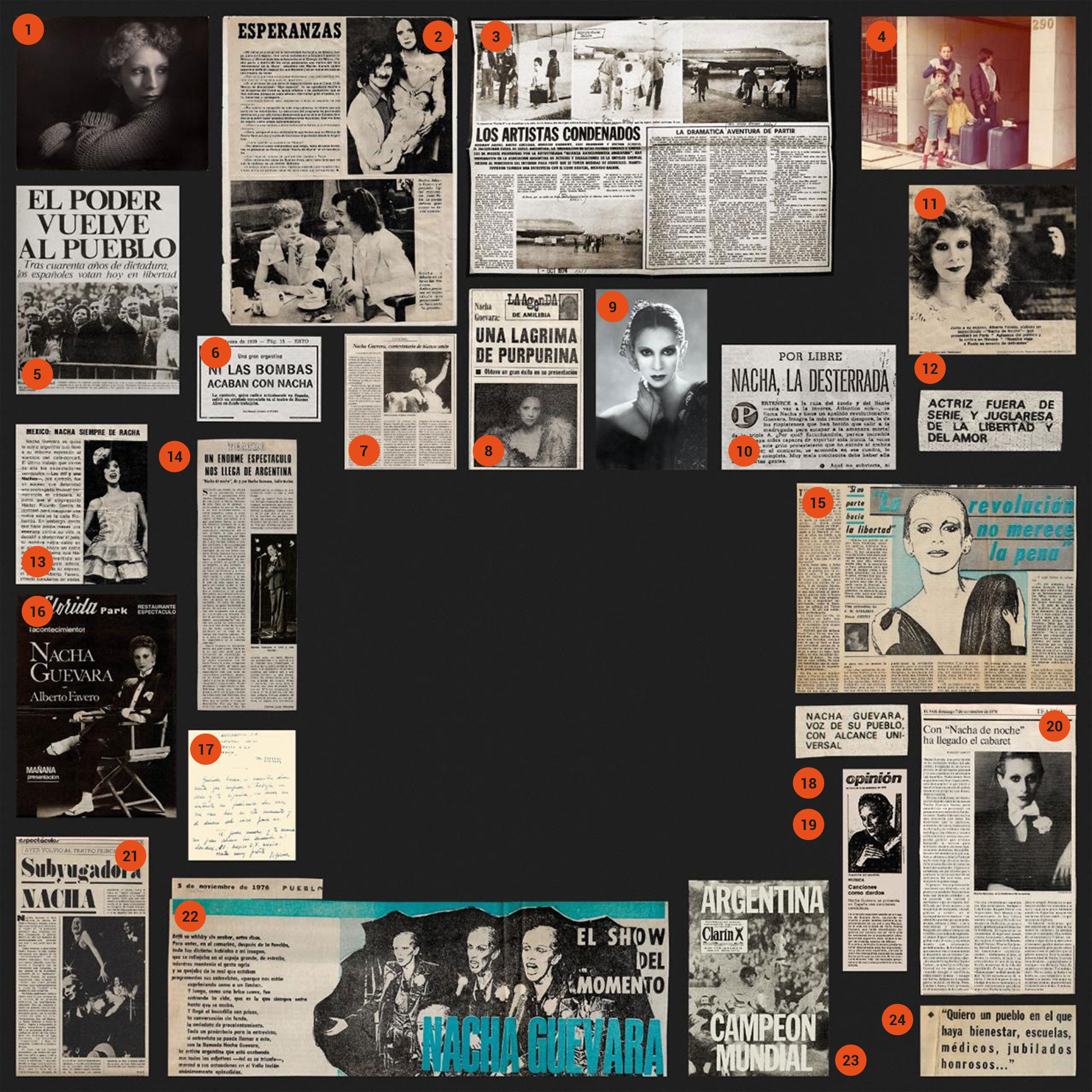
The adversity in the country seemed insurmountable. Mexico, on the other hand, represented a rebirth for Nacha Guevara. She arrived in that country thanks to the assistance of the great Spanish actress Nuria Espert, who wrote to her offering a home and money until she could return to work.
Nacha was forced into a nomadic way of life: fourteen moves in nine years, with stays in Peru, Mexico, Spain and the United States.
Her second period of exile began on 2 January 1976, as a direct consequence of her political impertinence. She was threatened by the Triple A after refusing to stop singing songs such as ‘Yo te nombro’ [‘I Call You’] and ‘¿De qué se ríe, señor ministro?’ [‘What are you laughing about, Minister?’].
Spain welcomed her as it emerged from Franco’s long dictatorship. In 1977, encouraged by her Spanish representative, Nacha became the first to record a Spanish version of ‘Don’t Cry for Me Argentina’. This led to an opportunity to audition in London with Harold Prince, for Andrew Lloyd Webber and Time Rice’s musical Evita, a role that would result in a move to the United States.
Over the years, her time in exile strengthened her conviction that artists must wage the fight through their art, creating beauty while upholding the freedom out of expression.
‘What is exile? It is very hard to explain unless you have lived it; it’s an experience that cannot be shared. The most difficult thing is to accept that you have to begin again, because there is a loss of identity and a new setting: you have to explain who you are, what you can do, what you are good for. You have to explain it to yourself and to others’.
‘Our only weapons are song and poetry, so I refuse to perform in my own country as long as the current state of affairs remains unchanged’.