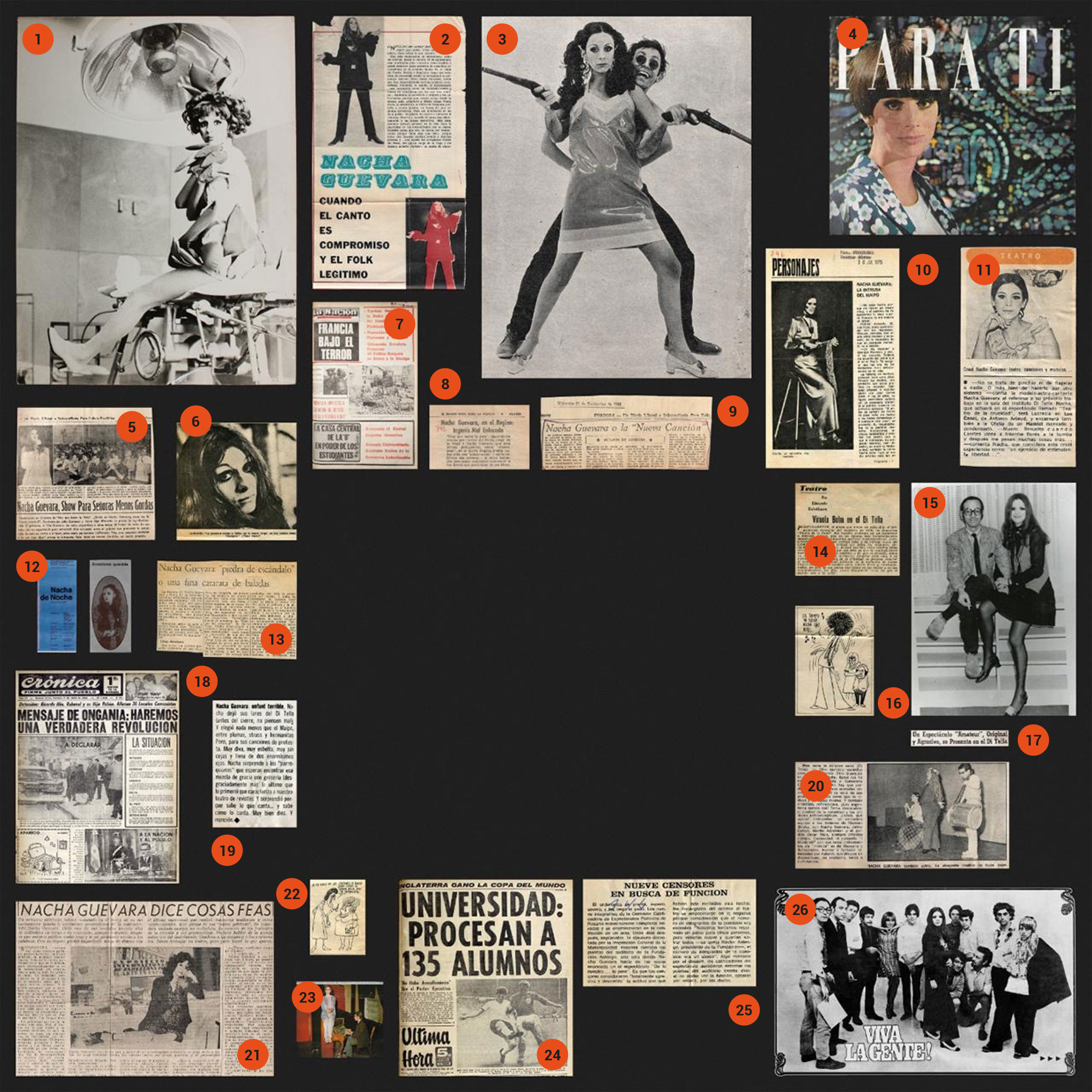
In the 1960s, Buenos Aires was experiencing its own revolution. Amidst art, youth and politics, a generation emerged that was determined to question everything in a provocative and ironic manner, be it family, morals, language, sex, fashion or art. At the epicentre of the movement, for at least a portion of this generation, lay the Instituto Di Tella. Founded in 1958, the Di Tella became an unexpected space of freedom and creativity, a laboratory of aesthetic disobedience, and a refuge. There, an art form was being practised that challenged hierarchies, mocked solemnity and mixed the cultured and the kitsch, the sublime and the absurd.
The Di Tella maintained a lively dynamic despite the prevailing political oppression: in June 1966, General Onganía overthrew President Illia and ushered in a conservative dictatorship. After the ‘Noche de los Bastones Largos’ [‘The Night of the Long Batons’] — a night of violent repression at the University of Buenos Aires on 29 July 1966 — hundreds of scientists and researchers were forced into exile. This brain drain delivered a severe blow to Argentine culture, which would survive, though it was under constant suspicion. The coming years were filled with major social, political and cultural changes, both in the country and internationally, with the occurrence of events as diverse as the protests of May 1968 in France and the 1969 moon landing.
It was against this backdrop that Nacha Guevara emerged as a representative of the Nueva canción [New Song] movement with her concerts at the Teatro Payró. In 1968, she arrived at the Di Tella with a handful of songs translated from the French as well as other compositions full of absurd humour and social criticism. She made potatoes and tomatoes talk, questioned the rules with a banana in her hand, and turned irreverence into her own language.
Nacha confronted the Onganía regime on her album Anastasia querida [Dear Anastasia] (1969), titled in homage to the writer Boris Vian and his French contemporaries, who used the name to refer to censorship, as if it were a person. In ‘El tiempo no tiene nada que ver’, her version of Georges Brassens’ song ‘Le temps ne fait rien à l’affaire’ [‘Time Has Nothing to Do with It’], she repeats the word boludo (idiot), considered vulgar at the time, sparking controversy among Buenos Aires society and shattering the limits of what was permitted in the music of the day.
Nacha had dreamed of becoming a dramatic actress, but instead she became a sharp-tongued, rebellious pop star.
After suffering much censorship and in the context of a political and economic crisis, the Di Tella closed its doors in 1970.