In the early 1970s in Argentina, art was being created against the backdrop of the military dictatorship (the self-proclaimed Argentine Revolution), as well as repression, political violence and popular uprisings. Following the ‘Viborazo’ strike in Córdoba —a mass protest organised by workers and students on 15 March 1971 — General Levingston, the second de facto president of the military regime, was forced to step down, giving way to the arrival of the third, General Lanusse. The country entered a period of deepening tensions marked by an intensification of the activities of armed organisations, growing support for Peronism from those exiled abroad, and increasingly apparent social unrest. As Lanusse promoted the ‘Gran Acuerdo Nacional’ [‘Great National Agreement’] as a controlled means of transition to democracy, the government entered into talks with Perón, exiled in Spain. On 3 September 1971, the body of Eva Perón — stolen by a Navy commando unit in 1955 — was returned to him.
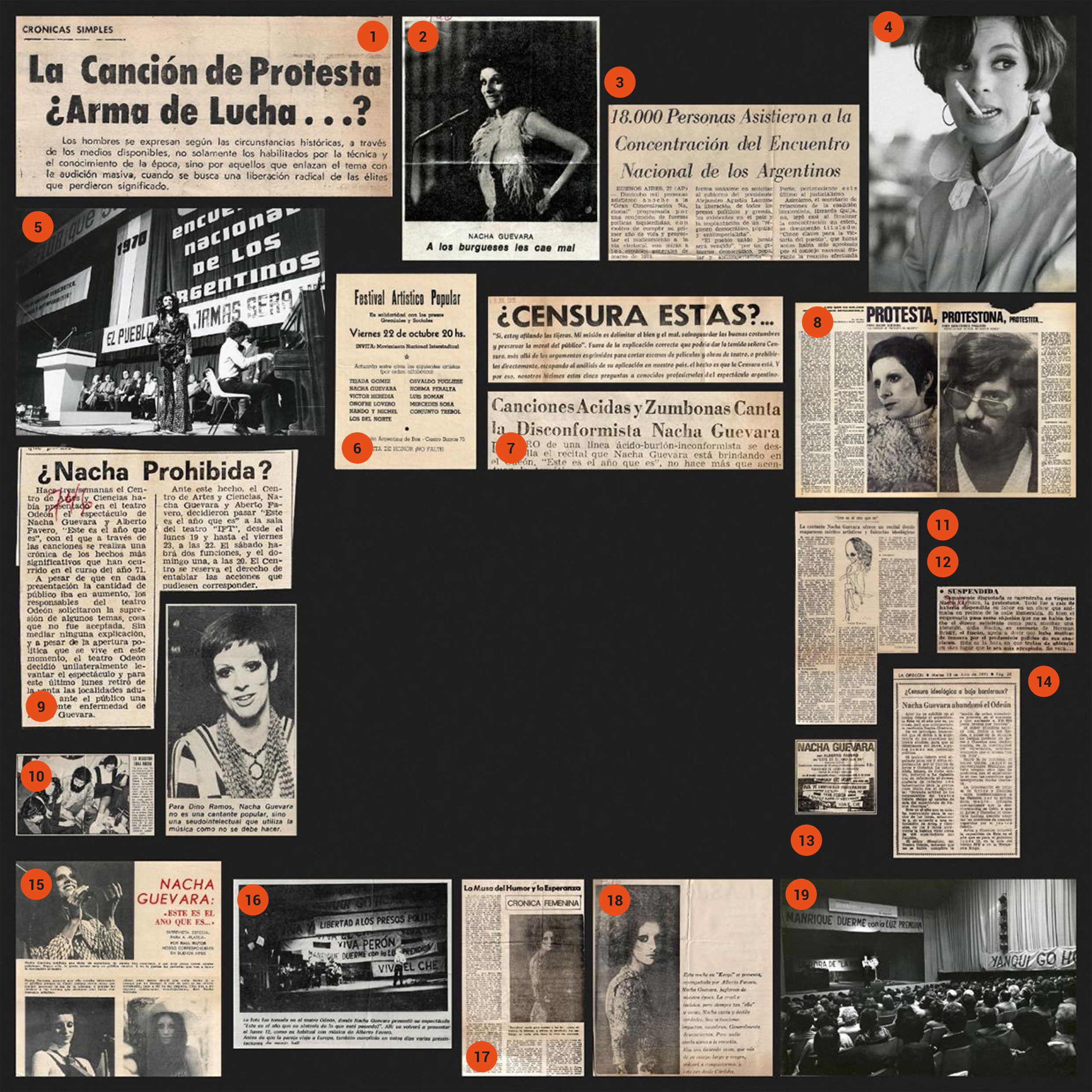
During that turbulent year at the beginning of the 1970s, Nacha Guevara premiered her new show, Este es el año que es [This Is the Year That Is], with musical direction by Alberto Favero and set design by Claudio Segovia. Recorded live on 22 and 23 July at the Margarita Xirgu theatre in San Telmo, the show marked a turning point in her career. After a period of performances with a more playful and ironic tone, she now adopted an openly political attitude. The stage was covered in banners featuring slogans such as ‘Release the political prisoners’, ‘Yankees go home’ and ‘Manrique’s afraid of the dark’, a reflection of the climate of social upheaval of the time. The programme included songs such as ‘Soldadito boliviano’ [‘Little Bolivian Soldier’], by Paco Ibáñez and Nicolás Guillén, about the assassination of Che Guevara, and ‘El avestruz’ [‘The Ostrich’], by Michael Flanders and Donald Swann, as well as other songs laden with irony and critical of contemporary reality. With biting humour, Nacha tackled issues such as authoritarianism, the Cold War, the Argentine government’s debt to the International Monetary Fund, and the failures of the military governments. Unlike many artists of her generation, she chose not to align herself with Peronism but instead maintained an independent voice.
Her album Este es el año que es was an artistic statement in the face of violence, censorship and repression. It is a record of a historic moment when, more than ever before, there was a drive to challenge and mobilise society.