Brodsky Marcelo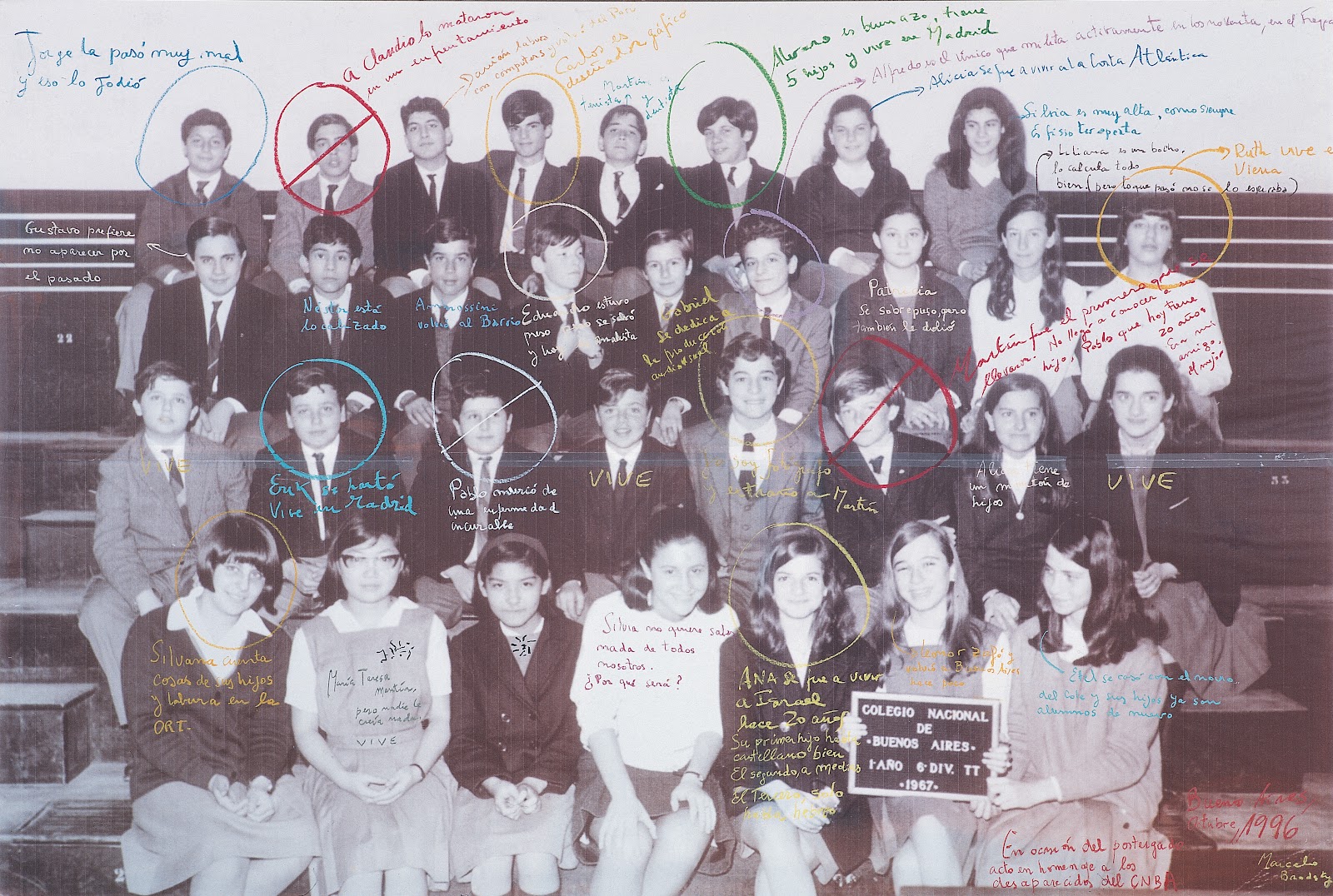
Marcelo Brodsky’s project offers a subjective narrative in which photography acts as memory.
Committed with the fight to defend social causes strictly related to the human rights, his work is largely related to situations inherent in violence in the times of military dictatorship in Argentina (1976-1983), the persecution and disappearance of citizens, echoing on the international scene, representing the voices of the peoples who denounce organized State terrorism in any territory. The photography in his work is a witness, a kind of “documentary service” when they combine archive material and documentation that the artist inscribes on the images, condensing traumatic experiences, vestiges of situations linked to horror and exile.
Marks, notes, colors, the laconic, archival tone of the information alludes to the impersonal discourse of history; calligraphy, untidy and urgent, invade the photographs pointing out, highlighting, accentuating the faults, the gaps caused by those who are no longer there, or the demands of a society. His work creates memory in time, an invisible bridge which, with its graphics, connects decades and defies oblivion, revealing the presence of silent bodies that speak from a not too distant past. By transposing familiar vernacular materials and personal testimony in the public sphere, the artist provides an opportunity for others to identify and be moved, allowing understanding of distant events. Upon returning from his exile in Spain, Brodsky used family photographs as a starting point for works that try to communicate the trauma of the lived experience. The artist positions himself from a personal point of view to invite the spectator to be moved, identify, generate empathy with the other and create a common space for reflection where individual memories can become collective. His work is displayed in multiple supports within the visual arts and editorial publications where the image is activated as a document blurring the limits between the artistic, the archive work, the videos, the installations, among others. Brodsky explores the ability of photography to provide a space for meditation between private memory and collective stories. It is thanks to his absolute knowledge of the use of the power of images and of the word that Marcelo Brodsky manages to transmit through his works a message that commits us as political individuals.